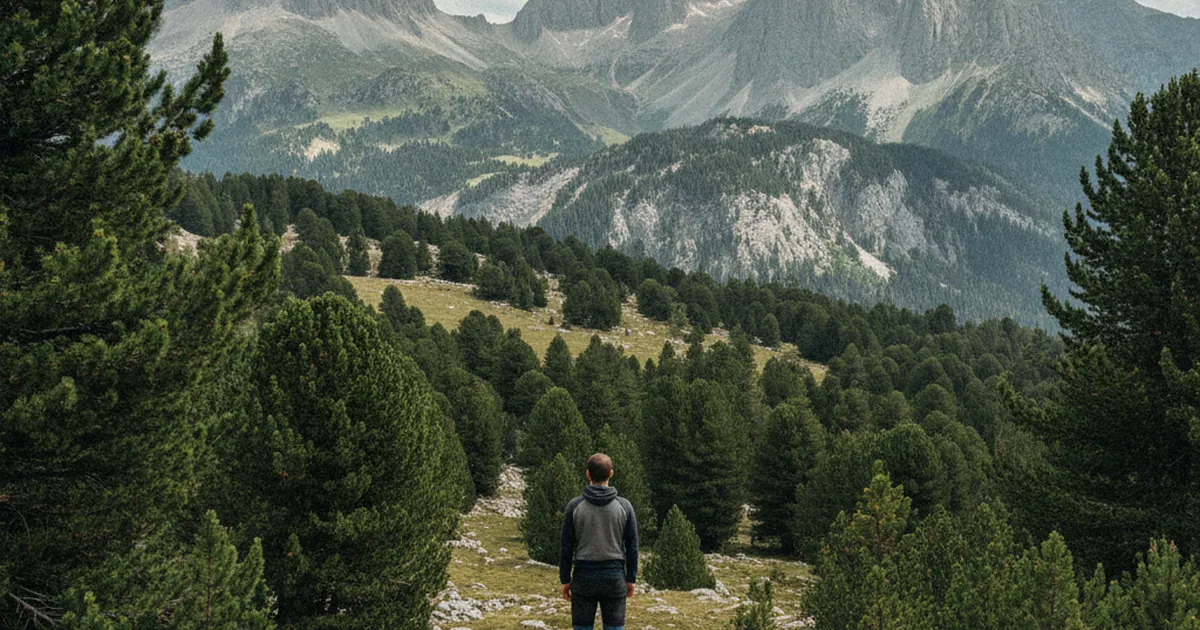
When the forest runs out and trees grow sparse, one tree still stands. The Swiss stone pine (Pinus cembra), known locally as the arolle, is the last tree of the mountain, holding its ground up to 2,600 metres before giving way to rock and permanent snow. In Haute-Savoie, you need to climb well above the pastures to encounter one, but the effort is worth it: this is a world unto itself, sheltering and feeding an entire ecosystem.
Built for the extremes
The Swiss stone pine colonises the subalpine zone, typically between 1,800 and 2,600 metres depending on slope and aspect. At these altitudes, the ground freezes for several months a year, winds lash the ridges, and snow can linger until July. The stone pine endures all of it. Its secret is slow growth paired with extraordinary longevity: some trees exceed 500 years old, occasionally reaching 800. A tree already growing during the Crusades may still be alive and producing seeds today.
You can identify it by its needles in bundles of five, a feature unique among the pines of the French Alps. Young trees have smooth, grey-green bark that cracks and turns pinkish with age. The cones stand upright on the branches, unlike the hanging cones of a spruce, and contain large, wingless, edible seeds. These seeds, sometimes called pine nuts or noix d'arolle, are one of the richest energy sources available to high-altitude wildlife.
The spotted nutcracker: the pine's gardener
The Swiss stone pine cannot spread on its own. Its seeds are too heavy to be carried by the wind, so it relies on a dedicated partner: the spotted nutcracker (Nucifraga caryocatactes). Each autumn, this bird buries caches of several seeds a few centimetres underground, sometimes hundreds of metres from the parent tree. Its spatial memory is remarkable: it can locate the vast majority of its stores even under 60 centimetres of snow. Some caches are inevitably forgotten, and those forgotten seeds germinate and grow into new trees.
The symbiosis is so ancient and so tight that the two species have co-evolved over millions of years. The stone pine cannot regenerate effectively without the nutcracker, and the nutcracker cannot survive a high-altitude winter without the pine's seeds. Watching a nutcracker work its way through a stone pine is one of the purest wildlife partnerships in the Alps. If you hear a repeated, rasping call from the branches overhead, look up.
Pine and larch, companions at the treeline
In the Alps, the Swiss stone pine rarely grows alone. Its usual companion is the European larch (Larix decidua), the only deciduous conifer native to the Alps. The two species complement each other naturally: the larch quickly colonises open ground, then the stone pine settles in beneath it, more patient, content to outlast the larch by centuries.
These mixed forests create some of the most distinctive mountain landscapes around. In autumn, when the larch turns gold and amber, the compact, twisted silhouettes of the stone pines stand out against the bright foliage. In summer, clearings are bathed in low evening light filtered through two kinds of canopy. If you are hiking in the subalpine zone, keep an eye on the vegetation: Swiss stone pines tell you that you have left ordinary forest behind and stepped into something wilder.
Where to find Swiss stone pines in Haute-Savoie
In Haute-Savoie, the best areas are the massifs that push high enough. In the Pays du Mont-Blanc, with summits topping 3,000 metres, stone pine stands survive just below the treeline on sheltered slopes. Over in the Giffre valley, the ridges and north-facing slopes above Samoëns reach sufficient altitude to harbour them.
Choose hikes that climb above 1,800 metres to actually encounter them. The Hauts-Forts loop above Les Gets crosses subalpine terrain where fine stands of stone pines mix with larch. The Pointe de Chavanette from Avoriaz also reaches the right altitudes, with open views across the subalpine forest and its characteristic dark clumps.
Avoid December to April for the best observation conditions: snow covers the ground and hides young growth and cones. The best windows are June-July, when the last snowfields are melting and the light is extraordinary, and September-October, when the larch is at peak colour and nutcrackers are busy stocking up.
A wood carved for centuries
The Swiss stone pine is not only an ecological keystone. Its wood is reddish, fine-grained, and carries a distinctive scent even after processing. Craftspeople in Savoy and the Aosta Valley have fashioned furniture, frames, and carved objects from it for centuries. In the Swiss canton of Valais, the tradition of the Stübeli, a communal room panelled in stone pine wood, is still alive today. The wood is believed to have natural insect-repelling properties.
In France, the Swiss stone pine is a protected species. Felling it, removing branches, or collecting its cones is prohibited. If you come across one on a hike, observe, take your photos, and leave the tree and any seeds on the ground untouched: a nutcracker may already have its eye on them.
The Swiss stone pine is a marker. When you meet one while hiking in Haute-Savoie, you know you have entered the high mountain, where nature sets its own rules. Take a moment to look for its upright cones among the branches, and listen for the rasping call of a nutcracker nearby. These quiet, unhurried moments are often the ones you carry home longest.