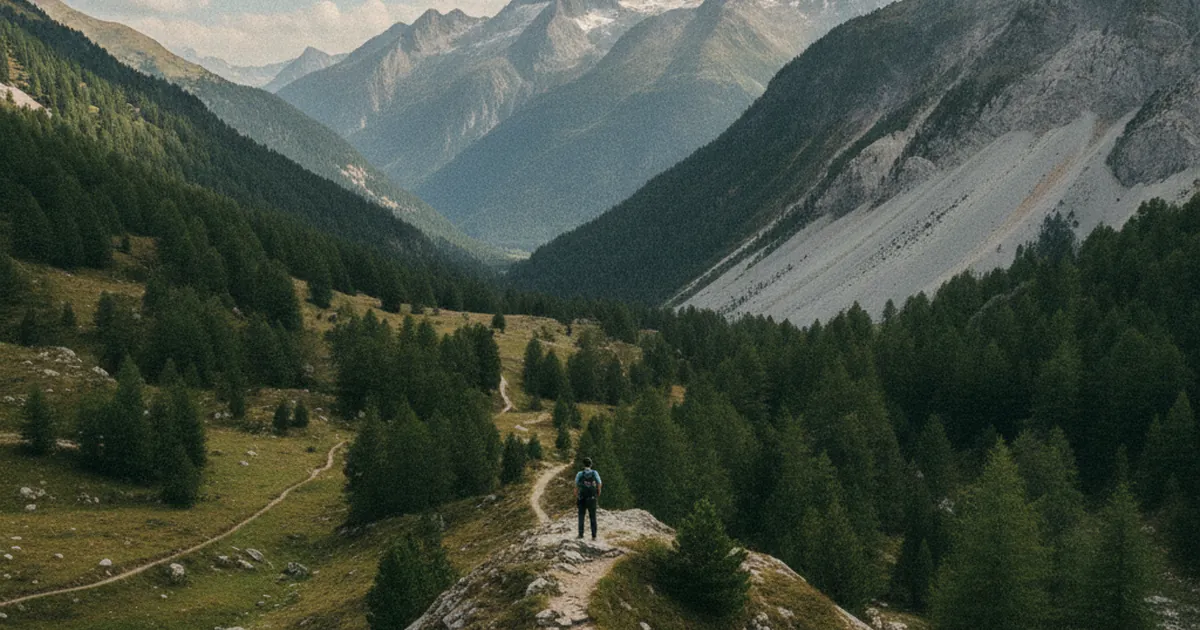
Everyone has heard of Chamonix. The name conjures up the biggest mountain faces in the Alps, the Mer de Glace, queues for the Aiguille du Midi cable car, and refuges packed solid every July. The valley's reputation is entirely deserved: it is one of the most spectacular alpine landscapes in Europe. But fame comes at a price. In the height of summer, some of the famous trails feel less like mountain paths and more like tourist corridors. If you want to hike in Haute-Savoie without following the crowds, Chamonix rewards those willing to look beyond the obvious.
A valley beyond its greatest hits
The instinct when arriving in Chamonix is to head straight for the icons: Lac Blanc, the Grand Balcon Sud, Montenvers. These routes are popular for good reason: they are genuinely spectacular. But the valley stretches for roughly fifteen kilometres, from Les Houches in the south to Vallorcine in the north, and each slope offers a completely different atmosphere. The north-facing Aiguilles Rouges side, across the valley from Mont Blanc, is quieter, more understated, and draws hikers looking for solitude and alpine wildlife.
The Aiguilles Rouges: the overlooked side
The Aiguilles Rouges nature reserve runs along the entire north slope of the Arve valley, directly facing the Mont Blanc glaciers. It is one of the richest protected areas in Haute-Savoie, yet paradoxically one of the least visited. The trails that wind between high-altitude lakes and sun-facing ridges offer unobstructed views of the Mont Blanc massif without the crowds on the main slope. In June, before peak season takes hold, the high pastures are still green and narcissi cover the grassy stretches.
Several starting points allow access to this side of the valley. Cable cars can shorten the ascent, but descending on foot is a satisfying option for anyone seeking quiet at the beginning or end of the day.
Argentière and Vallorcine: the forgotten ends
At the far end of the valley, Argentière and Vallorcine see far fewer visitors than Chamonix town. Argentière has its own glacier, its own alpine pastures, its own atmosphere, and a tight-knit mountain community that keeps genuine alpine culture alive away from the shops of the centre. Vallorcine, right at the northern tip of the valley, serves as a gateway into the Swiss canton of Valais and draws hikers looking to cross the border on foot or by bike through a granite landscape that is austere and quietly compelling.
Both villages deserve to be treated as bases in their own right, not just stages on the Tour du Mont Blanc. The change in atmosphere is real: fewer café terraces, more quiet, a different quality of afternoon light.
Timing makes all the difference
Seasonality is a more decisive factor in Chamonix than almost anywhere else in the Alps. In July and August, the main trails fill up by nine in the morning, which is why it pays to scout out quiet routes. In June, while some higher routes still carry snow, the lower slopes are clear and nearly empty. In September, the light shifts, the larches start turning yellow, and visitor numbers drop noticeably. Setting out early in the morning or in the evening (in summer, daylight lasts until around 9 pm) transforms the experience on almost any trail.
At six in the morning, even the Grand Balcon Sud can feel like a private path. That is not an exception: it is a hiking strategy that changes your entire relationship with a place.
Hiking around Chamonix, not just in it
The Mont Blanc region offers far more than the commune of Chamonix alone. Sallanches, Passy, Les Contamines-Montjoie, Combloux: these areas are within thirty minutes by road and offer family-friendly or more demanding trails without the tourist pressure of the main valley. It is often where local residents spend their own weekends.
Further afield, in other valleys across Haute-Savoie, alternatives abound. The Gorges de Tines at Sixt-Fer-à-Cheval make for an easy yet striking route in a setting entirely different from the glacial world of Chamonix: see the former Tines gorges and Le Mont. The Rochers de l'Aigle near Ayse can be explored in peace on a forested ridge loop above the valley: see the Rochers de l'Aigle.
What Chamonix teaches you about hiking
Hiking Chamonix beyond its iconic trails is above all a mindset. Accepting that the most famous route is not always the right one for you. Seeking stillness without abandoning the spectacular. Adjusting your departure time, your section of the valley, your season. The valley is generous to those who arrive outside the main flow. It reveals itself differently, more intimately, to those willing to look somewhere other than the highest summit.
Whether you are passing through for two days or spending a full week in the valley, there is always a trail that has not yet made it into your photos. That is what Chamonix looks like beyond the myths.