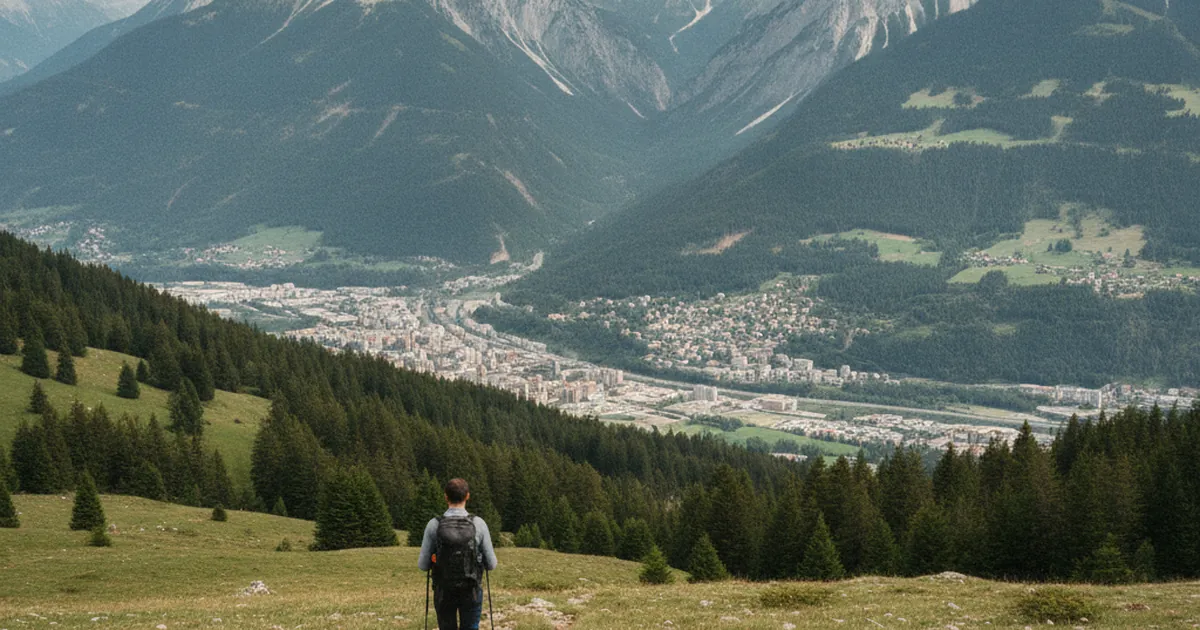
Cluses is one of those towns you drive through without stopping. Sitting on the main route between Geneva and Chamonix, it tends to be reduced to a motorway exit and a few roundabouts. That's a mistake: well-placed at the heart of the Arve valley, Cluses is actually an excellent base for hiking in Haute-Savoie. Several worthwhile massifs sit within easy reach, making it an underrated but surprisingly practical starting point.
A name that says it all
The word "cluse" is a geographical term describing a gorge carved by a river cutting perpendicular to a mountain ridge. That's exactly what the Arve did here, forcing its way through the rock to create a narrow corridor between the Faucigny hills to the north and the foothills of the Aravis range to the south. The town settled into this natural passage, and it's from this tight spot that the valley spreads in all directions.
Stand in the town centre and look around: slopes rise on every side. The floor is narrow, the Arve runs along the bottom, and forests begin almost immediately above the rooftops. This enclosed feel that can first seem claustrophobic is actually a randonneur's advantage: you're genuinely in the mountains, even when you're still at street level.
Cluses and precision industry
Before it became a hiking base, Cluses was France's watchmaking capital. For two centuries, workshops here produced watch movements and precision mechanical parts, a tradition that shaped the entire identity of the valley. That expertise gradually evolved into the décolletage industry, the high-precision machining of metal components. Today, the "Vallée du Décolletage" concentrates hundreds of specialist firms from Cluses through Marignier and Ayse.
If you arrive in wet weather, the local museum dedicated to this watchmaking and industrial heritage is worth an hour before or after a hike. And the town centre has enough cafés, bakeries and restaurants to fuel you properly.
Le Môle: the summit watching over the valley
From Cluses, it's hard to miss on a clear day: Le Môle, a clean-profiled summit dominating the northern side of the Arve valley. Its high point at 1,863 m is reachable from several surrounding villages. From Marignier, just a short drive away, the route Le Môle from Marignier covers 16 km with 1,600 m of elevation gain. Expect around 5h50 for this very difficult-rated loop. It's a serious ascent best suited to experienced hikers. The payoff at the top is proportional: the valley stretches out below, and on a clear day, Lake Geneva appears to the north.
The Tour d'Agy for an easier outing
If you'd rather keep things gentle, the area has a quieter option. The Tour d'Agy, starting from La Joux in Saint-Sigismond, is a 7.46 km loop with just 167 m of elevation gain. It takes around 1h45 and is rated very easy. It's the kind of walk that suits families, or anyone who just wants to stretch their legs without committing to a half-day climb. The Agy plateau offers open views over the surrounding ridges.
Châtillon-sur-Cluses: the viewpoint above
A few kilometres up the hillside, Châtillon-sur-Cluses completely changes your perspective on the valley. From this perched village, the geography clicks into place: the town below, the Arve winding through, the massifs on either side. The area also offers its own starting points for exploring the heights, and it's often the route taken by hikers who want to avoid the valley floor.
A central position among the massifs
Cluses's real strength is its location. By car, you're within reach of several major hiking areas:
- West: the Giffre valley and walks around Samoëns and Sixt-Fer-à-Cheval
- South-east: the Bargy massif, the Aravis range, the Glières plateau
- East: up the valley towards Sallanches, then Chamonix and the Mont-Blanc massif
- North: the Faucigny hills, Le Môle, the Swiss border
Cluses is not a destination in itself. It's a pivot point. That's precisely why it deserves serious consideration when planning a hiking trip in this part of Haute-Savoie.
Getting there
Cluses station is served by the regional TER line between Saint-Gervais-les-Bains and Geneva, with frequent daily services. It's a good option if you want to arrive without a car: you drop your bag at the station and head out on foot or by local bus. By car, Cluses is directly accessible from the A40 motorway. Midweek arrivals are smoother during summer: the Friday evening and Saturday morning queues towards Chamonix are a well-known seasonal fixture.
Cluses doesn't make an obvious first impression. But for those who take the time to use it as a base, it opens up a range of possibilities that few valley-floor towns can match: direct access to the massifs, a functional town centre, and solid public transport links. Sometimes the best hiking bases aren't where you'd expect them.