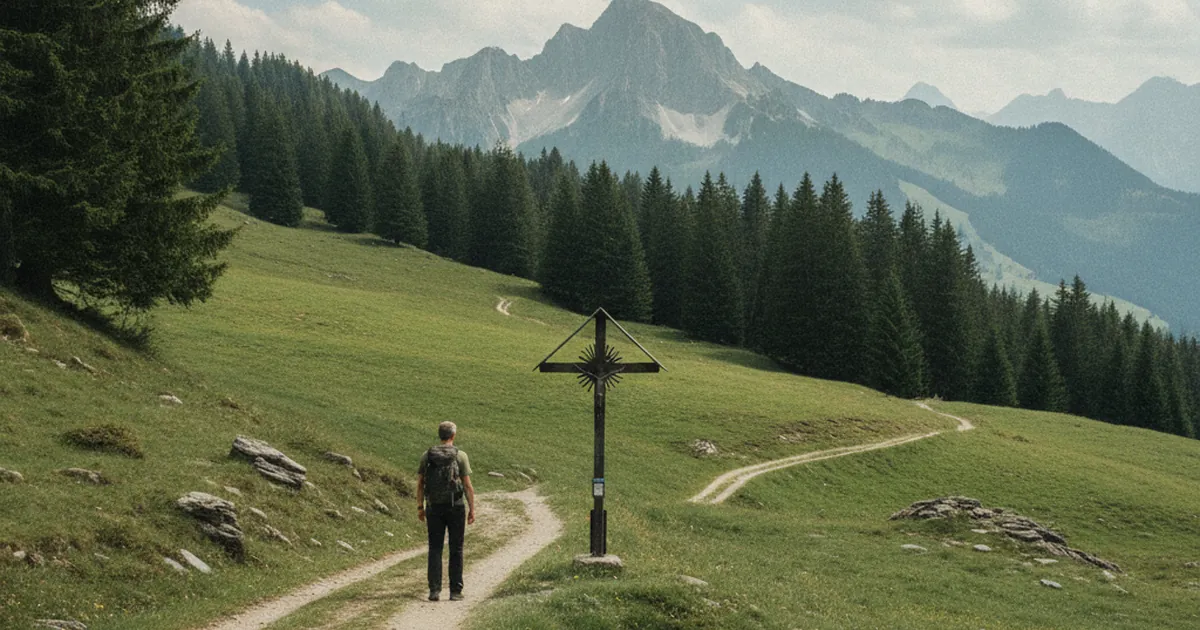
On the footpaths of Haute-Savoie, a small wooden or iron cross sometimes catches your eye at a crossroads. It has stood there for decades, maybe longer: weathered by winters, tilting slightly, half-hidden by moss. Most walkers pass without noticing. Yet these wayside crosses belong to the deepest and quietest layer of Savoyard heritage. They carry no altitude, offer no view. What they carry instead is memory: the long, rooted memory of a rural Catholic world that shaped these valleys long before the hiking trails arrived. Before you set out to hike in Haute-Savoie, spending a moment with them changes the way you see the paths beneath your feet.
A presence going back centuries
Wayside crosses have existed across Europe since the Middle Ages. They marked crossroads, village entrances, parish boundaries and the approaches to chapels. People raised them for many reasons: to give thanks for a recovery from illness, to commemorate a fatal accident, to mark a procession route, or simply to ask for divine protection over travellers and livestock. In Haute-Savoie, the terrain multiplied the occasions. Difficult passes, unpredictable mountain trails and isolated summer pastures all called for some form of intercession. Almost every hamlet had its crosses; almost every path had its devotional markers.
What a cross tells you
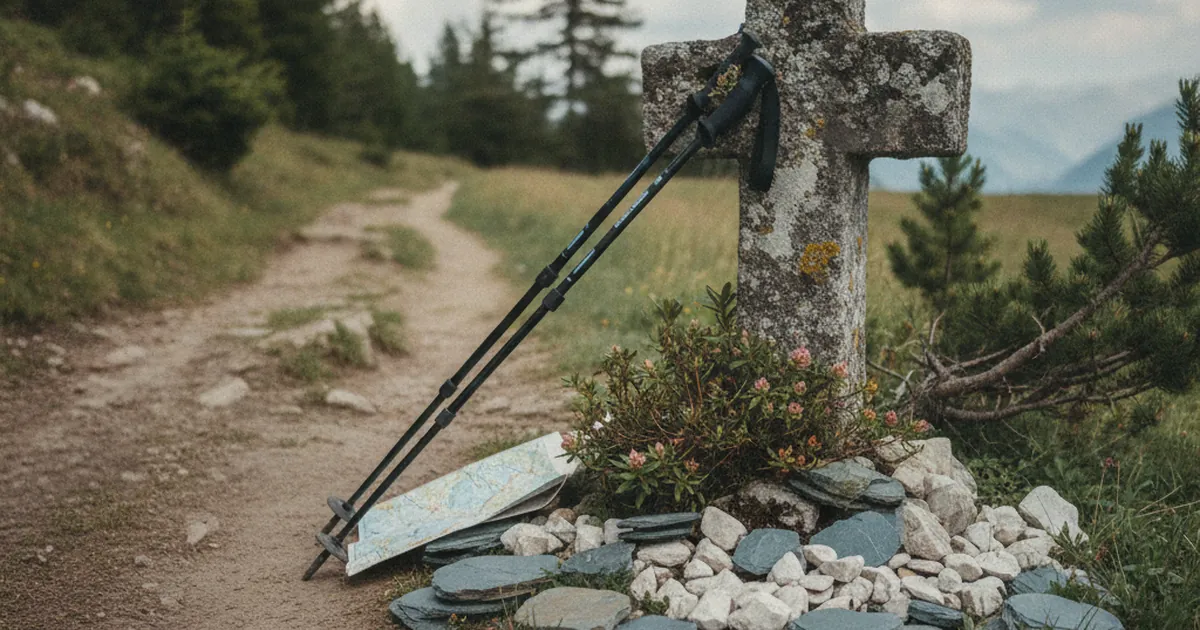
No wayside cross is without meaning. Its shape, material and location all carry information about the territory and the people who lived there. The oldest are carved from local stone, sometimes with real skill: a plain Latin cross, a full Calvary scene with a Christ figure, a niche sheltering a Virgin or a saint. In the villages of the Chablais, you often find crosses decorated with carved floral motifs, a signature style of regional craftsmen in the seventeenth and eighteenth centuries. In the Giffre valley, some crosses still have rusted ex-votos hanging from their shaft: small objects left behind in thanks for a grace received.
A date is sometimes carved into the stone or the wood. A seventeenth-century inscription makes these objects direct witnesses to a history older than most of the roads that now run through the same villages. Other crosses are more recent: erected in the twentieth century to honour a family member or mark a significant local event.
Finding them while hiking
You do not need to leave the trail to encounter wayside crosses. They appear naturally along marked footpaths, sheltering under trees at junctions between forest tracks, standing at the edge of hamlets the path crosses through. You just need to look up from the ground and slow down for a moment.
The hike to the chapel of Jacquicourt via les Lanches passes through an area of dense rural heritage where these devotional markers still line the old paths. A similar atmosphere awaits around Allevès, a village on the edge of the Bauges massif, where the walk toward la Figlia winds through preserved hamlets that time seems to have barely touched.
Looked after or left behind
The condition of these crosses varies enormously. Some are cared for by the commune or by local families: freshly repainted every spring, surrounded by flowers in summer. Others lean at dangerous angles, eaten by lichen, forgotten on a track no one uses any more. A handful of local associations are working on inventories and restoration projects, particularly in the Aravis and Bornes ranges.
The most remarkable examples are protected as listed monuments, but the vast majority of wayside crosses fall outside any official scheme. Their survival often depends on the goodwill of nearby residents, who repaint a tilting cross, stabilise its base, or simply flag a threatened one to the local mayor. That kind of signal can sometimes be enough to trigger a proper restoration.
Heritage worth a second look
Wayside crosses do not appear in hiking guides. They have no technical data sheet, no altitude figure, no waymarker number. Yet they belong to the Savoyard landscape as fully as the stone drinking troughs, the communal bread ovens, or the roadside shrines set into old walls. Their discretion is part of what makes them worth seeking out: they do not demand attention. They wait to be seen.
Every time you walk past one without looking, you pass by a piece of local history. Every time you stop for two minutes to read a carved date or study a sculpted detail, you reconnect with a memory that no one deliberately erased, but that many people have simply stopped reading.
These crosses are there, on almost every path, somewhere between the trail marker and the next mountain hut. They are not asking for much. Just a glance that takes the time to stop.