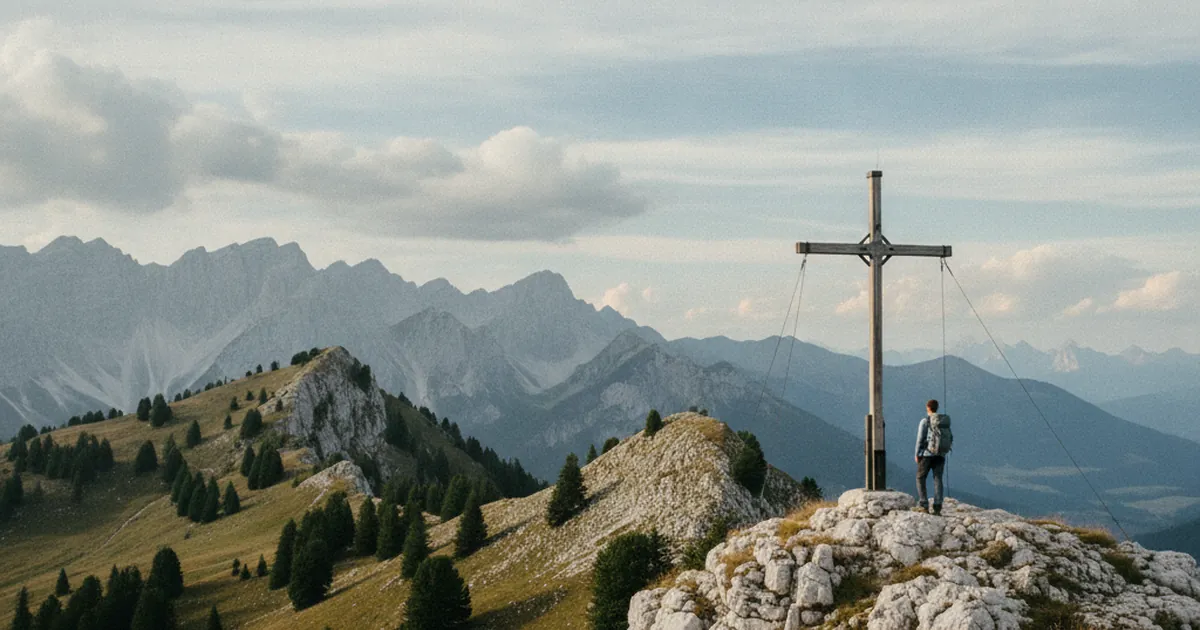
Reach the top of almost any peak or pass while hiking in Haute-Savoie, and chances are you will find a cross standing there, weathered and silent against the sky. Metal, wood, stone, sometimes bearing a Christ figure or a carved Virgin, these structures are as much a part of the Alpine landscape as the fir trees and high summer pastures. But where do they come from? Who puts them there, and why?
Medieval and Christian origins
The tradition of summit crosses dates back to the Middle Ages, in the wake of the Christianization of Alpine territories. Monks and priests traveling through these regions sought to place Christian symbols on high ground that was often associated with older beliefs and mountain spirits. Planting a cross on a col or a summit was a way of asserting that Christian faith extended even to these inhospitable heights that many valley dwellers feared.
The Council of Trent in the sixteenth century reinforced the practice, encouraging visible markers of faith in public spaces. Mountain parishes multiplied crosses at crossroads, passes, and summits visible from the valley below, creating a network of spiritual landmarks across a vast and often dangerous territory.
Protecting travelers and shepherds
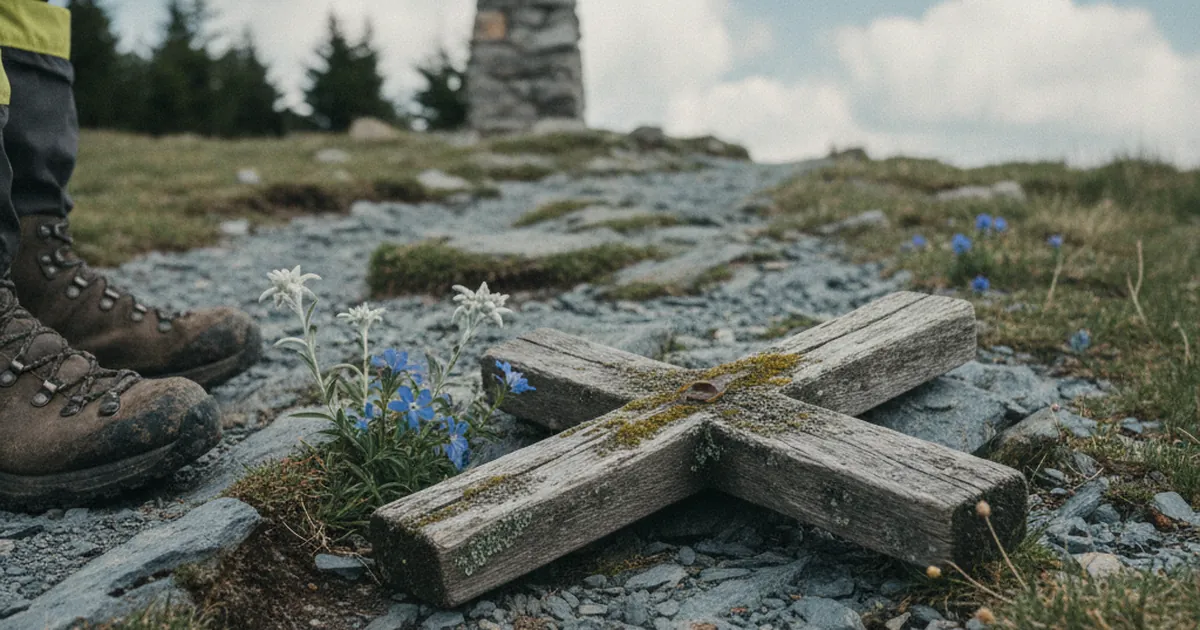
Beyond its religious symbolism, the summit cross served a very practical purpose: reassurance for those crossing the high ground. Mountain travel in the Alps was genuinely hazardous. Sudden storms, rockfalls, icy passes even in summer. Shepherds moving their flocks to the high pastures, traders crossing cols with their loads, smugglers passing through the night: all found in the cross both a landmark and an object of devotion.
Before setting off again, you would touch the cross. Leave a branch, a flower, sometimes a coin. These simple gestures placed the traveler under divine protection for whatever lay ahead. In the Giffre valley and across the Chablais, many pass crosses survived for centuries, maintained by communities in the valleys below who considered them shared heritage.
Memorial crosses and ex-votos
Many of the crosses you encounter today have no medieval roots. They are memorial crosses, placed to mark an accident, a disappearance, or a significant event. The mountains have always taken lives. Every decade, hikers, climbers, and mountain guides die in the Alpine massifs. Families or friends arrange for a cross to be placed at the site of an accident, a kind of inverted ex-voto: not to give thanks for a rescue, but to maintain a presence where someone was lost.
Other crosses commemorate collective events. Wars have left their mark on the mountains. After 1918 and again after 1945, many communes had crosses erected on visible summits to honor the village dead. These war crosses often carry civic as much as religious weight: they speak of a community that paid a heavy price.
How does a cross get to the summit?
The logistics are more involved than they might appear. Carrying a metal cross weighing tens of kilograms to a summit takes real organization. For a long time, it was a parish matter: villagers took turns hauling the pieces up by hand, in the spirit of a communal work party and celebration. These procession-style ascents were memorable events for entire communities.
Today, helicopters have simplified things considerably. Many recent crosses were airlifted to their summits in a matter of minutes. But the tradition of the communal climb has not entirely disappeared. Mountaineering clubs and parishes still organize volunteer workdays to replace a damaged cross or install a new one. These are meaningful occasions that combine physical effort with shared symbolic purpose.
The hike to the chapelle de Jacquicourt from Les Lanches is a good way to see how the sacred settled into Alpine landscapes well beyond the summits themselves. The Tour d'Agy circuit is another route where crosses and small chapels punctuate the path and invite you to pause along the way.
A living tradition
Crosses age. Metal rusts, wood rots, lightning strikes. The question of maintenance and replacement arises regularly. In France, crosses on private or municipal land are in principle the responsibility of the landowner. Those on state-owned land fall under different rules and are sometimes subject to sharper debates.
In some cases, the question of religious symbols in public spaces comes back into view. A handful of crosses on public land have been subject to legal challenges, raising questions about France's secular principles. These debates make clear that the summit cross is not a simple relic of the past: it remains a living object, charged with meaning and with contemporary tensions.
For those who do not share the Christian faith, the summit cross can still be a compelling historical and heritage object. It tells us something about the fears, beliefs, and solidarities of communities that lived in these mountains for centuries. In that sense, it is worth the detour, whatever path you take to reach it. The next time you stop in front of a cross on a ridge, take a moment to look closely. There is often a plaque, a date, a name, and behind those few words etched into the metal, a whole story.