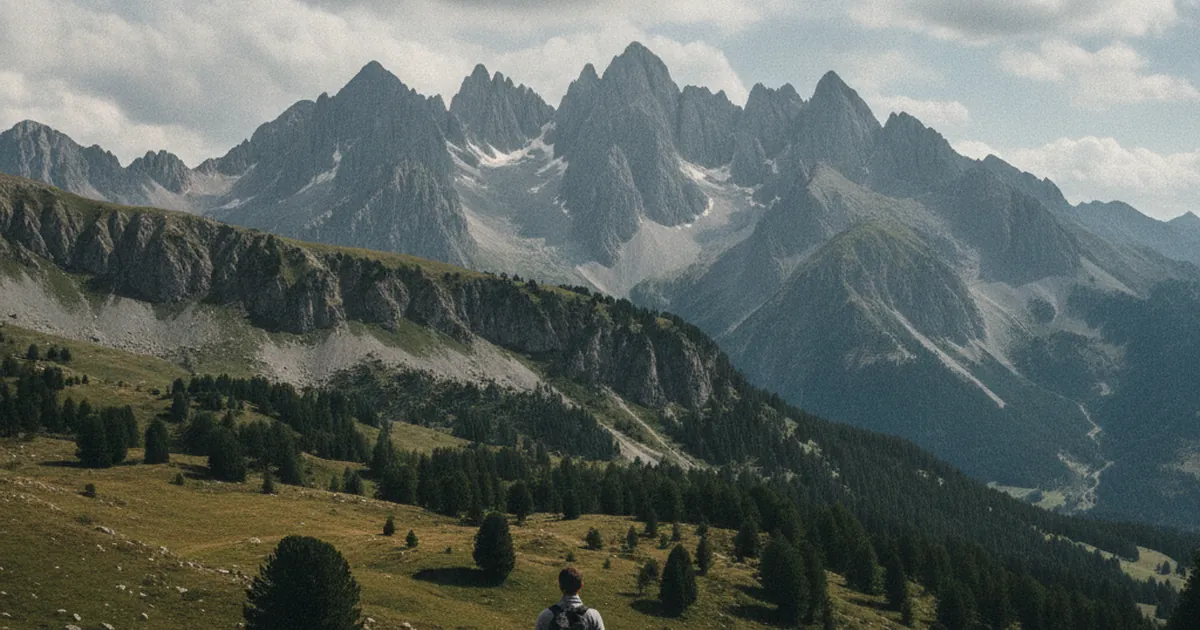
You recognise them at a glance. The seven summits of the Dents du Midi form a distinctive jagged ridge east of Lake Geneva, in the Swiss canton of Valais. But it is often from Haute-Savoie that you see them best: the Chablais provides a natural, open grandstand facing those Swiss ridgelines. You do not need to climb high to find them in front of you. Sometimes they appear around a bend in a mountain road, between two alpine pastures, and the view simply commands your attention. For anyone hiking in Haute-Savoie, they are as much a part of the landscape as the local summits.
Seven peaks, one unmistakable silhouette
The Dents du Midi form a massif of seven summits arranged in an arc, all above 2,900 metres. The highest, the Haute Cime, reaches 3,257 metres. What strikes you is not so much the altitude as the outline against the sky: these serrated ridges are recognisable at any distance, in any light.
In winter, snow clings to the north-facing slopes well into spring. In summer, the limestone takes on orange and ochre tones in the evening, especially as the sun drops towards the lake. The overall shape, a kind of comb tilted eastward, is visible from dozens of kilometres in every direction.
They stand in Switzerland, in the canton of Valais, near Saint-Maurice and Champéry. Yet from France, you often read them better than from many Swiss vantage points. The angle is right, the distance ideal for taking in the relief as a whole.
The best viewpoints from the French Chablais
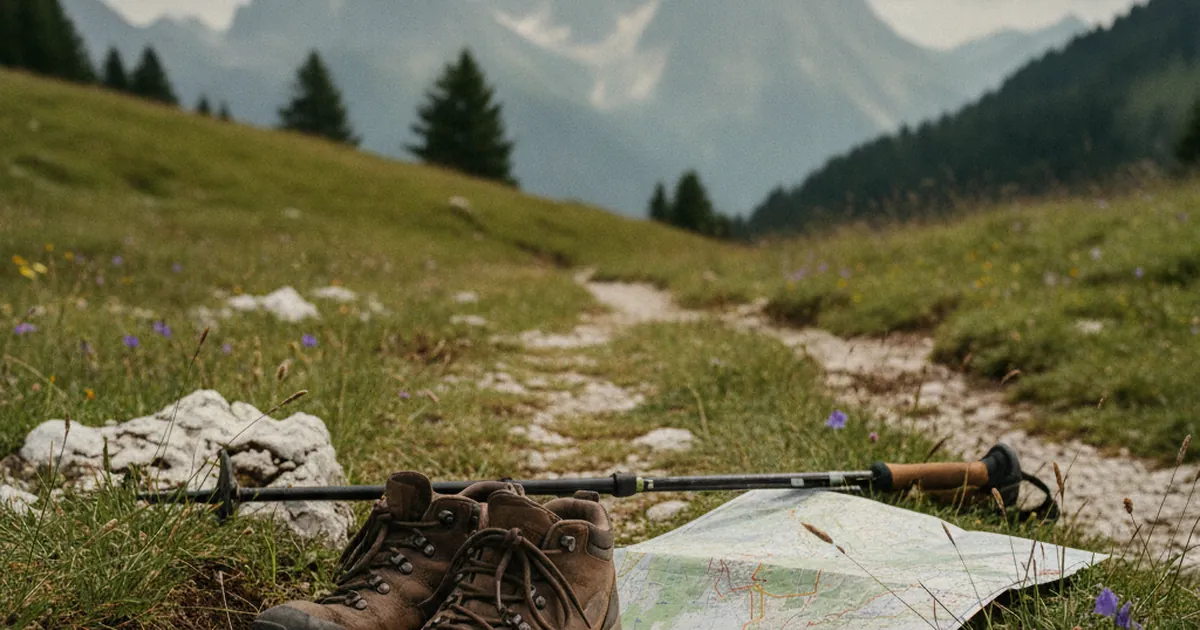
Several spots in Haute-Savoie offer remarkable views of the Dents du Midi without demanding long approaches.
The Morzine area is one of the most generous. From most of the surrounding heights, the Valaisan massif dominates the horizon to the east-northeast. Lake Montriond, tucked below in a wooded cirque, frames the ridgeline beautifully in the late afternoon, when raking light deepens the relief. The Montriond lake loop from Ardent takes in this view with a very manageable amount of ascent, suitable for families or early-season outings.
Heading up towards the Avoriaz heights, the Hauts-Forts loop offers a different experience: the Dents du Midi accompany you for much of the climb, always ahead, growing larger as you gain altitude. Few routes keep them so consistently in view throughout.
Further west, from Les Gets, the angle shifts but the spectacle holds. The Mont Chéry, easily reached by summer lift, delivers a panorama eastward where the Dents du Midi stand out clearly between several lines of border ridges.
Reading what you see
When you look at the Dents du Midi from the French Chablais, the seven peaks are not always all visible at once. Depending on your position, some overlap or stack behind one another. From Morzine or Les Gets you can usually count five or six distinct summits. The order from left to right as seen from France corresponds roughly to the sequence alpinists follow when traversing them from the Swiss side.
What also stands out is their constant presence. On a clear day, the Dents du Midi are visible from Geneva and from the shores of Lake Geneva. Across Haute-Savoie they close the eastern horizon for tens of kilometres, forming the backdrop to Chablais hikes whether you are at low altitude or on a ridge.
When to see them at their best
In summer, evenings are the prime time. The late-day light catches the western faces and tints them red and ochre. That is when you understand why these ridges have fascinated painters and photographers for two centuries. When the sun sets over the lake, the sky behind the peaks often turns extraordinary.
In winter and spring, the contrasts between snow and rock bring out the shapes even more sharply. A blue sky after a fresh snowfall gives the Dents du Midi a striking relief as seen from the Chablais pastures. Snowshoe routes in the Morzine area offer winter views of the massif that are worth the outing in their own right.
A practical note: summer mornings tend to be hazy on the Geneva side. Afternoon and evening light generally give the clearest views towards Switzerland. In autumn, the Dents du Midi sometimes take on violet hues at dusk, one of the finest colour palettes of the season in this part of the Alps.
A skyline that helps you navigate
Beyond the visual pleasure, the Dents du Midi serve a practical purpose for anyone who walks regularly in the Chablais: they orient you. As soon as you spot them, you know where east lies, you have a rough sense of how far you are from the lake, and you can read much of the regional geography in a single glance. They are landmarks as much as they are a spectacle.
The Dents du Midi are not in France, but they belong to the landscape of Haute-Savoie as surely as any local summit. They add depth to Chablais panoramas, mark the horizon from the lakeside hills, and appear unexpectedly from a col you assumed had no view. Finding them becomes a game on every hike. From where will I see them today? The answer is almost always: from more places than you expected.