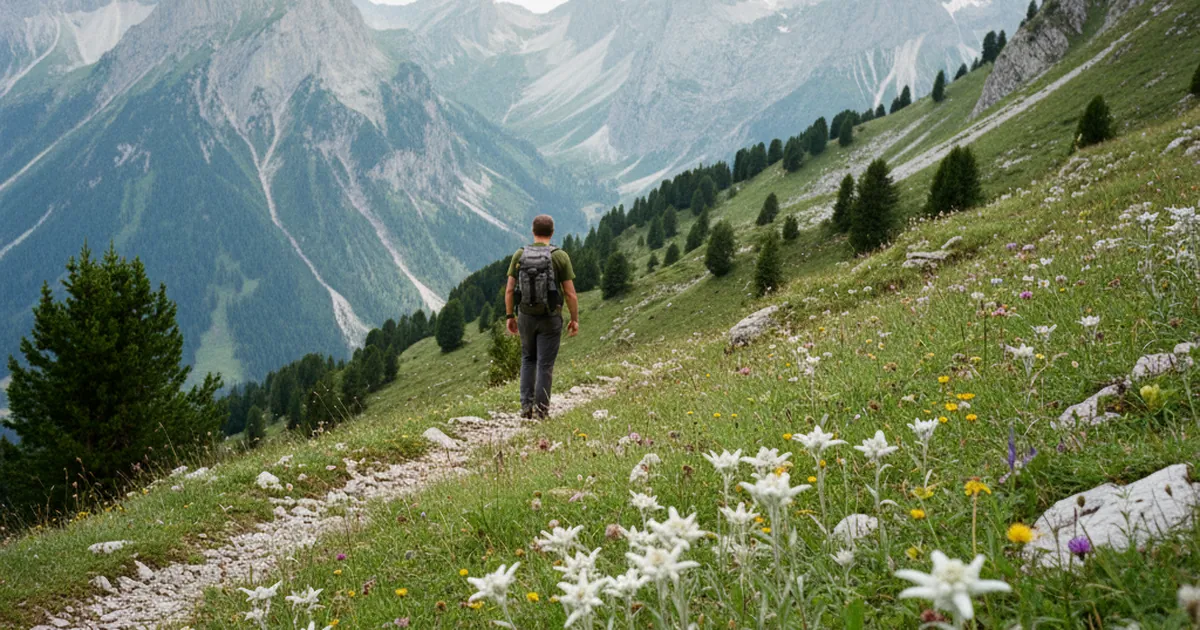
No plant symbolises the Alps quite like edelweiss. It has been romanticised as rare, dangerously hard to reach, and the ultimate gift a brave mountaineer could offer. Reality is more nuanced, and far more interesting. Here is what you actually need to know about Leontopodium alpinum before heading out to explore the trails of Haute-Savoie.
What exactly is edelweiss?
Edelweiss (Leontopodium alpinum) belongs to the Asteraceae family, the same group as sunflowers and daisies. What looks like a single flower is actually a composite structure: several small yellow tubular florets at the centre, surrounded by star-shaped woolly white bracts. That distinctive shape is what makes it so recognisable at a glance.
The thick white hairs covering the entire plant (stem, leaves, and bracts) are not purely decorative. They serve a functional purpose: filtering the intense ultraviolet radiation found at high altitude, reducing moisture loss in dry and windy conditions, and providing slight insulation for the most vulnerable parts. This is an adaptation to alpine conditions refined over thousands of years.
The plant is perennial. It can live for several years in the same spot, sometimes forming small colonies on a scree slope or limestone cliff face. Its growth is slow and its leaf surface modest. It produces relatively few seeds each year, which explains why it is so vulnerable to repeated picking.
Is edelweiss actually rare?
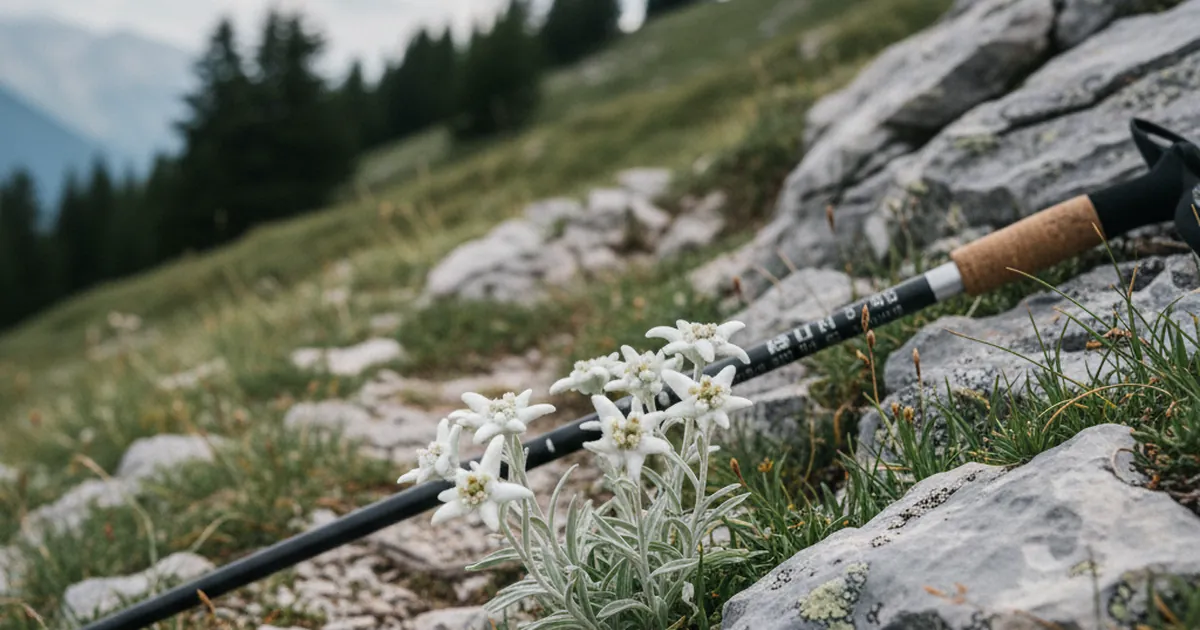
The reputation of edelweiss as a rare plant is largely a myth, kept alive by popular culture and centuries of intensive picking. In reality, Leontopodium alpinum is found throughout the European Alps wherever the right conditions exist: limestone substrate, sufficient altitude, south-facing slopes with good drainage.
In heavily visited and easily accessible areas, it has genuinely disappeared. Decades of picking, trampling and tourist pressure have wiped out the most visible populations. But in quieter sectors, on rocky faces or grassy slopes well off the main trails, edelweiss grows in sometimes substantial numbers.
In practice: if you look in the right places, away from the busiest paths, you have a good chance of spotting some. The idea that you need to scale an inaccessible cliff face is mostly the stuff of fairy tales and mountain romance novels.
Where to find it in Haute-Savoie
Edelweiss requires specific conditions:
- Limestone substrate: it is a strict calcicole. On granite or gneiss, you will not find it.
- Altitude between roughly 1,700 and 3,000 metres, in the subalpine and alpine zones.
- Sunny, often rocky or semi-rocky, well-drained slopes.
In Haute-Savoie, the limestone massifs offer the best conditions. The Chablais is particularly well suited: the high slopes around Montriond or Morzine, the limestone ridges above 1,800 metres, provide exactly the habitat the plant needs. The hike up to the Pointe de Nantaux, which climbs past 2,100 metres through mixed grassland and rock terrain from Montriond, crosses exactly this kind of ground. The loop of the Pointe de Chavanette from Avoriaz, peaking at 2,201 metres, offers similar conditions.
Further east, the cliffs and high pastures of the Aravis massif are equally well suited: limestone, south-facing, open and exposed.
Flowering runs from July to September depending on altitude, peaking in July and early August. That is when the woolly white bracts are most distinct and easiest to spot from the trail.
A legal protection worth knowing
Edelweiss has been a protected species in France since 1982. The law prohibits picking, uprooting, mutilating or transporting the plant. This protection covers the entire French territory, including areas outside nature reserves, and applies to the whole plant, not just the flower.
A few good habits on the trail:
- Look without touching. Even brushing the bracts can damage a plant that took several years to reach that size.
- Do not trample around it. Getting too close often means crushing young seedlings invisible in the surrounding vegetation.
- Take photographs from the trail, crouching down without putting your hands in the plants.
Violations can lead to fines. Beyond the legal aspect, the logic is simple: leaving the plant in place means you and others can find it again in exactly the same spot next season.
Edelweiss does not need the myth to be remarkable. Its biology, its adaptations to extreme conditions, the way it clings to limestone cliffs above 2,000 metres: that is more than enough. For curious hikers, the limestone massifs of Haute-Savoie hold real encounters in store, provided you know where and when to look.