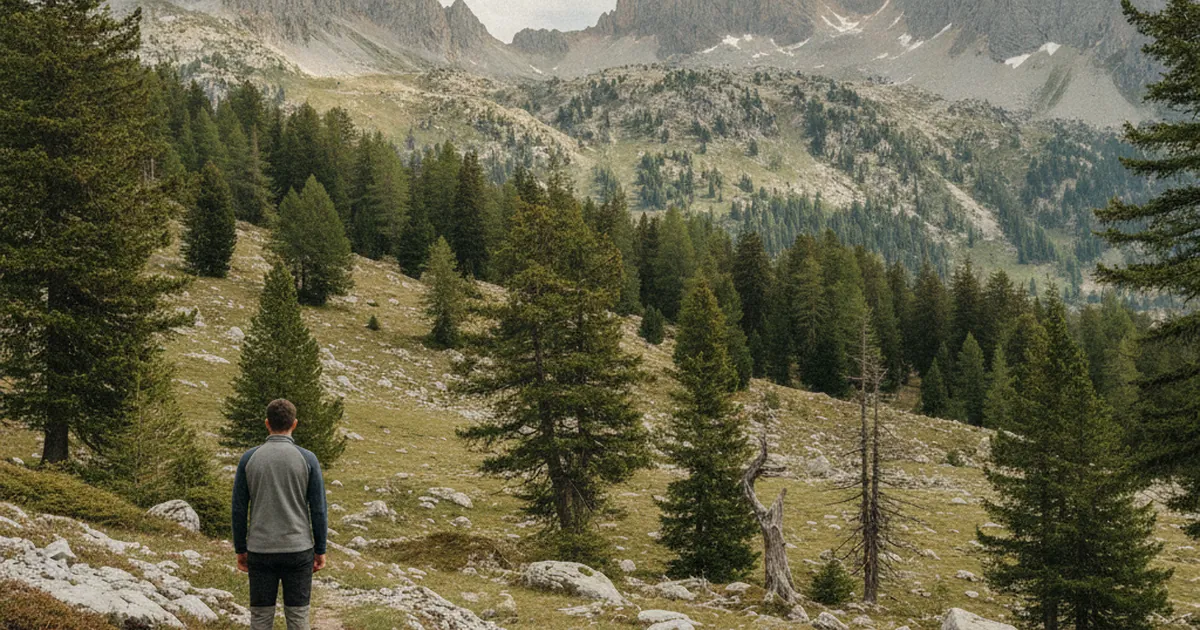
You've probably noticed that green boundary you can see from the valley floor: an invisible line separating dense forest from open alpine meadow. It runs across every mountain slope in the Alps, somewhere between roughly 1,800 and 2,200 metres depending on where you're standing. There's nothing accidental about it. Hiking in Haute-Savoie means learning to read this landscape and understanding why the trees stop where they do, not a hundred metres higher.
Temperature: the primary driver
A tree needs a long enough growing season to build wood. In the mountains, that season is measured in days when the temperature stays continuously above a minimum threshold, around 6 to 7 °C. The higher you climb, the longer the winters stretch, the later the snow melts in spring and the earlier it returns in autumn. Beyond a certain point, the growth window becomes too short. The tree simply cannot store enough reserves to survive the next winter.
So it isn't deep winter cold that kills the forest. Spruces and Swiss stone pines handle hard frost perfectly well. What stops them is the absence of enough summer warmth. One key detail: it's the soil temperature, not air temperature, that matters most. South-facing rocky ground exposed to direct sun can be far warmer than shaded slope soil at the same elevation.
Aspect: the same altitude, two different worlds
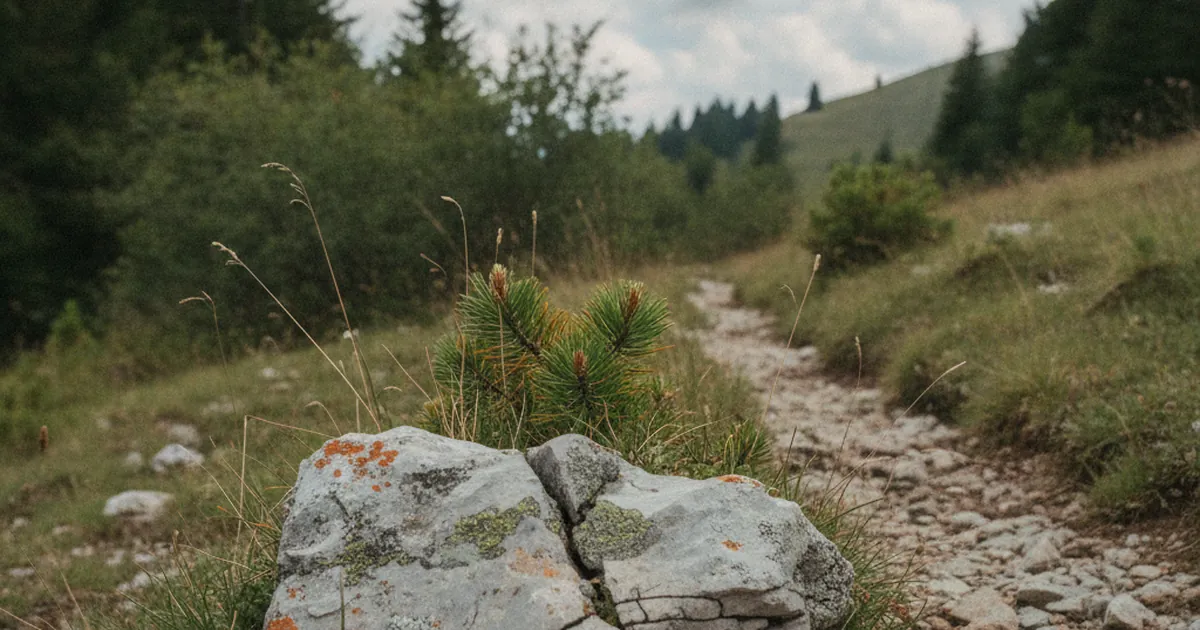
Look at any slope in Haute-Savoie. On sunny, south-facing flanks, the tree line can sit a hundred to two hundred metres higher than on the shaded north-facing side. The difference comes from heat balance: a south-facing slope captures more solar energy, warms its soil more effectively, and extends the growing season.
In the Aravis-Bornes range, you can see this contrast clearly from certain cols. On one side, fir trees climb high on sunny slopes. On the other, north-facing walls stay forested much lower down, where snow lingers well into summer and direct light is scarce for months.
Wind is another factor. At high elevation, winter gusts damage buds, desiccate needles, and mechanically limit growth. That's why trees that push beyond the tree line often grow twisted and stunted. Botanists call these wind-battered thickets "Krummholz", a German word for the bent, low-growing forms you sometimes encounter just above the forest edge.
Human influence: a boundary pushed down over centuries
The tree line you see today is often not entirely natural. Since the Middle Ages, mountain communities have cleared slopes to create pastures for livestock: burning, felling, intensive grazing. These practices pushed the forest down in many valleys.
In areas like the Chablais, old maps show forests that once grew higher on certain slopes before generations of herders turned them into summer grazing grounds. Today's alpine pastures are partly the result of centuries of human work, not just a climatic constraint.
This also means that some pasture areas, if left ungrazed, would see the forest reclaim ground. Mountain pines and spruces readily colonise abandoned alpine meadows. You can find visible examples in sectors where summer grazing has retreated over recent decades.
What climate change is shifting
Recent mountain observations point clearly in one direction: the tree line is rising. Winters are shorter, summers longer and warmer. Spruce and larch seedlings are appearing at elevations where they were absent a few decades ago.
The process isn't uniform. Where soil is deep enough, trees advance. On rock faces, scree, or avalanche paths, colonisation stays blocked. In heavily grazed areas, young shoots get eaten before they can establish.
This upward shift has real consequences. It gradually changes the open landscapes we associate with the high mountains, alters the biodiversity of alpine grasslands, and can affect slope stability in certain areas.
Reading the line from the trail
Watching the tree line as you walk is one of the most concrete experiences the mountains offer. You often cross it without noticing, then turn around and see the difference: closed canopy on one side, open sky and summits on the other.
The Hauts-Forts loop from Morzine takes you through several vegetation belts as you climb: broadleaves low down, mixed forest, then spruces, then the gradually thinning edge before the high-altitude meadows open up. It's a good way to feel these transitions that structure the mountain landscape.
The Têtes from Plaigne d'Étry also offers a close reading of these stages, with slopes of very different aspects along the same route.
The forest doesn't stop by accident. It stops because conditions change: warmth runs out, wind sets the rules, the soil can no longer sustain a full growing season. That line you cross on every high-altitude walk holds a story of climate, ecology, and human history that the landscape carries in silence.