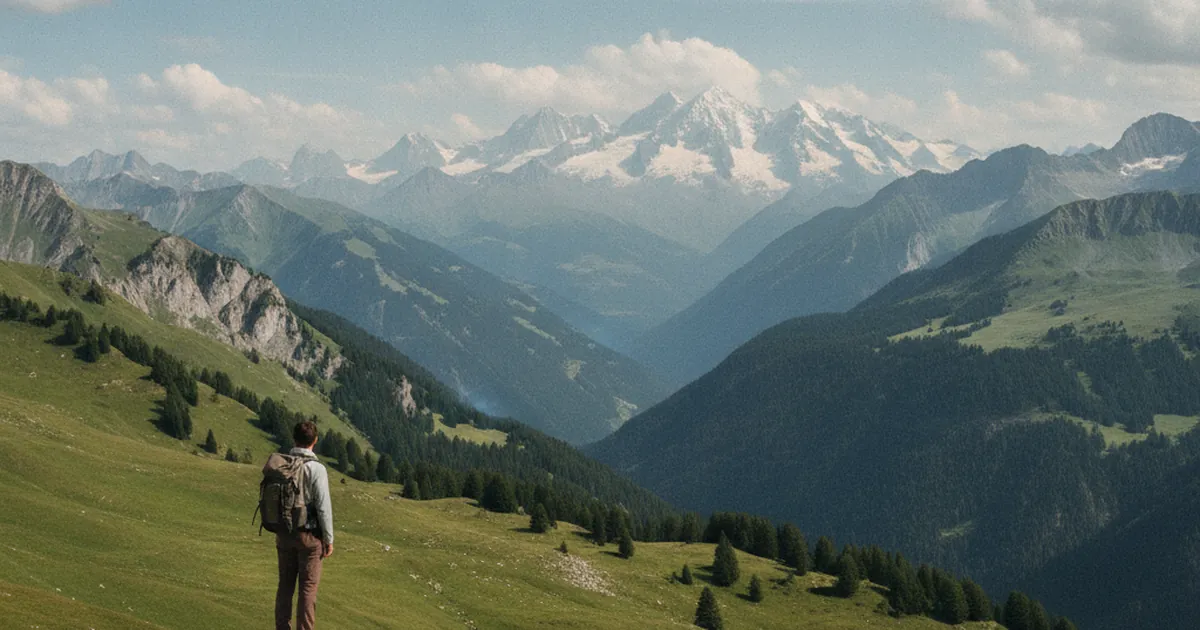
Mont Blanc dominates the skyline from almost anywhere in Haute-Savoie. Its summit, at 4,808 metres, sits above every other peak in the Alps and catches the eye the moment it appears between two ridges. Yet many hikers assume you need to be a mountaineer to truly experience it. That's not the case. Haute-Savoie's trails offer dozens of accessible viewpoints, sometimes without serious technical difficulty, where you can take in the great white giant in full. The trick is knowing where to look.
Why a viewpoint earned on foot is different
There's a real difference between seeing Mont Blanc from a café terrace and discovering it from a belvedere you reached after two hours of walking. It's not about sporting pride: it's about your relationship with the landscape. When you arrive breathless on a grassy summit and the white mass suddenly fills your field of view, the panorama is nothing like any photograph. You sense the depth, the layered valleys, the actual scale of the massif dwarfing everything else. The glaciers gleam, the ridges cut clean lines against the sky, and you understand instinctively why this mountain captivates people so completely.
The best part: this kind of experience is within reach of the vast majority of hikers. You just need to pick the right trail, in the right spot, on the right day.
The Pays du Mont-Blanc: the closest views
The most logical area for close-up views of Mont Blanc is, of course, the Pays du Mont-Blanc. Villages that frame the massif give access to marked trails that quickly climb to open viewpoints. You don't need to push into extreme altitude: from around 1,500 or 1,800 metres, the nearer summits fall away behind you and Mont Blanc reveals itself in full.
The Prarion, above Les Houches, is a well-known belvedere but not an exhausting one. The path is steady and well-marked, rewarding intermediate hikers with a 360-degree view of the massif, the Savoyard glaciers, and the valleys stretching toward Switzerland. This is the kind of route that suits people who want a real climb without any alpine commitment.
The Arve valley also offers several entry points for this kind of outing. From certain villages on the valley floor, forested paths break out onto high pastures with direct views of the massif. These routes are often less crowded than the classic circuits around Chamonix, which is precisely what makes them worth knowing.
Les Hauts Forts from Morzine or Les Gets
Further north, in the Chablais massif, several summits let you spot Mont Blanc from a distance. This kind of view lacks the immediacy of a climb from Les Houches, but it has its own appeal: you see the massif in a wider context, set against other ranges and other valleys.
Les Hauts Forts, above Morzine, is one of the strongest examples. This summit rises above 2,400 metres and offers, in clear conditions, a panorama that stretches to the Mont Blanc massif to the south-east. The Hauts Forts loop is a demanding hike with significant elevation gain, but it stays within reach of regular hikers. The summit view is one of the most generous rewards in the area.
From Les Gets, the ridges linking the various high pastures offer regular windows onto the Mont Blanc massif. These shorter circuits suit families or walkers who aren't chasing a summit but want a beautiful, open mountain landscape.
Pointe de Chavanette from Avoriaz
Avoriaz is a resort perched above 1,800 metres. This high starting point makes it easier to reach summits above 2,000 metres without a lengthy climb. Among the worthwhile routes in the area, Pointe de Chavanette from Avoriaz delivers impressive views over the Swiss Prealps and, in favourable conditions, the Mont Blanc chain in the distance.
This kind of high-altitude hike is particularly well-suited to July and August days when valley heat is oppressive. Start early from Avoriaz and you get cool air and ideal light for sweeping panoramas.
Key things to know before you go
- Weather is everything. Mont Blanc generates its own microclimate and can cloud over quickly, even on a sunny valley day. The best views usually come early, between 7 and 9 in the morning.
- The best season runs from late June to early October. In July and August, visibility tends to be best in the morning. In September, the air is often cleaner, early snow coats the upper peaks, and the trails are quieter.
- A light pair of binoculars transforms the experience: from a distant viewpoint, you can make out individual glaciers, roped teams on the high ridges, and details the naked eye simply misses.
- Always check the difficulty of your route before you leave. Some viewpoints require serious elevation gain; others are easy at a gentle pace. Match your choice to your own condition and that of your companions.
Mont Blanc doesn't hide. It just takes a little effort to be truly seen. Whether you set out from the alpine meadows at its foot or from the Chablais ridges two hours away, the massif offers a different view from every angle, in every season, and at every hour of the day. That is what makes it an endlessly rewarding horizon for anyone who loves hiking in Haute-Savoie.