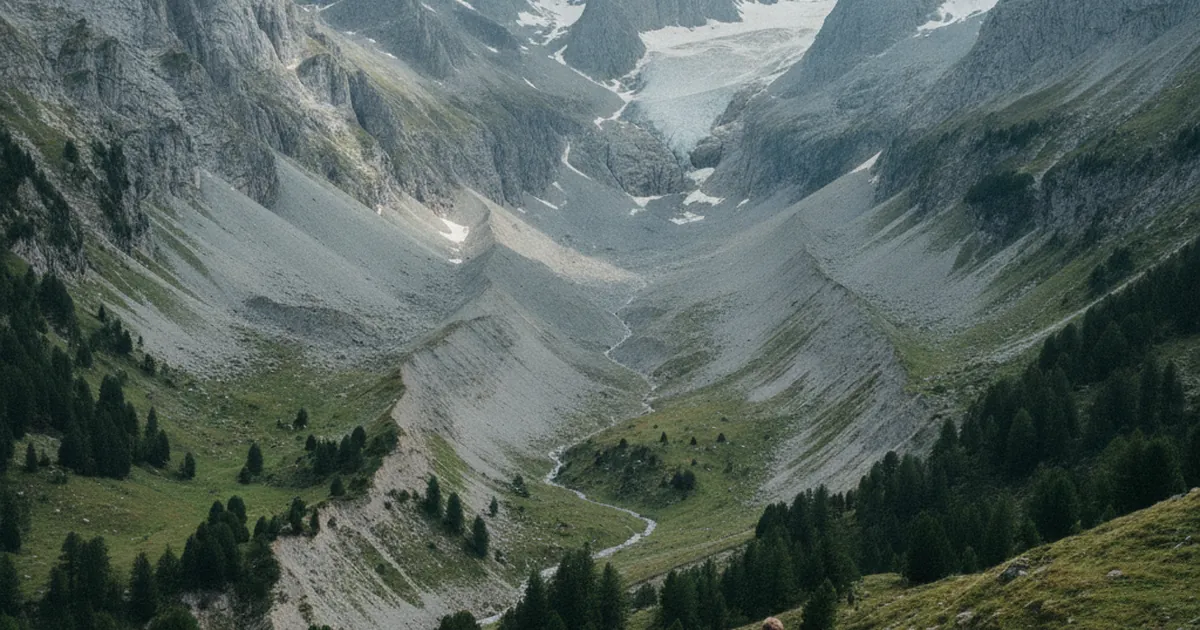
Every time you head out onto the trails of Haute-Savoie, you're crossing millions of years of geology compressed into a few kilometres of path. Among the most legible landforms, moraines stand apart. These accumulations of debris left by glaciers tell a story the landscape preserves long after the ice has gone. Learning to recognise a moraine from the trail changes the way you see the mountain.
What exactly is a moraine?
A glacier is not just a river of ice. It's also a giant bulldozer that tears rock from the walls as it passes, transports it for tens or hundreds of kilometres, and eventually deposits it. All that accumulated material, rock, gravel, clay, erratic boulders, is what we call a moraine.
What sets a moraine apart from a random pile of stones is its unsorted character. You'll find blocks of all sizes, often angular because they were torn directly from the rock face, mixed with fine material such as glacial clay, also known as rock flour. This soil is fertile but unstable. The vegetation that colonises it differs noticeably from the rocky terrain around it, which makes moraines easier to spot with the naked eye.
Different types of moraines
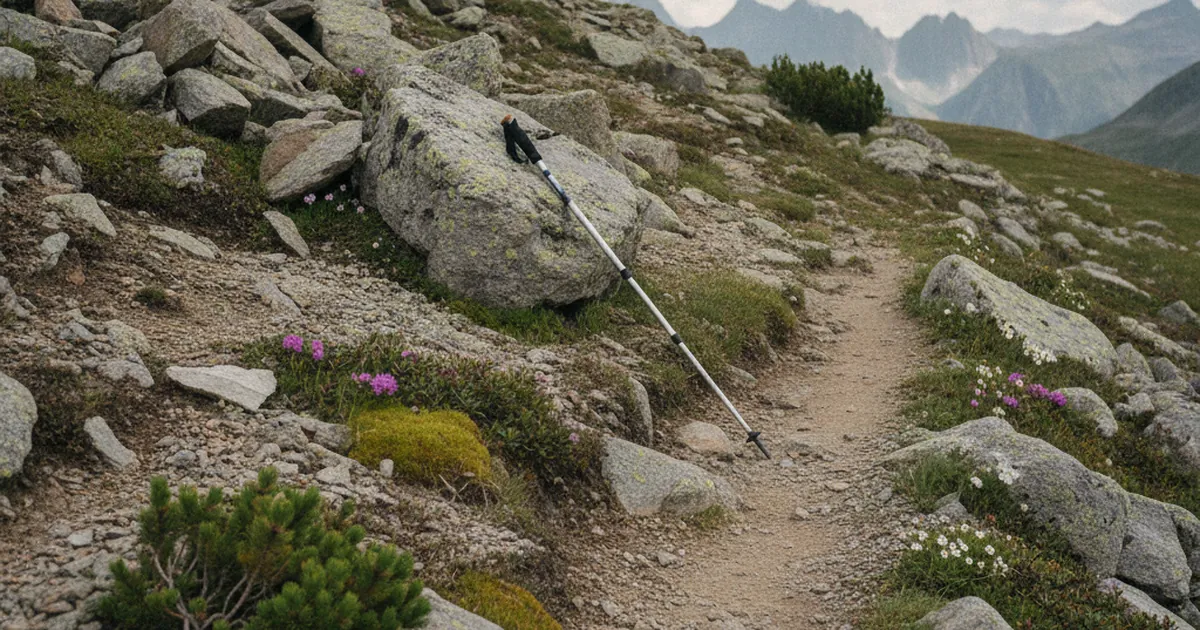
All glaciers produce moraines, but not in the same location or the same way. Depending on their position relative to the glacier, geologists distinguish several types.
- Lateral moraines form along the flanks of the glacier. When the ice retreats, it leaves two parallel ridges of debris that mark the former width of the glacier.
- Terminal moraines (also called end moraines) mark the point where the glacier stopped or slowed for a long period. They often appear as a curved arc across a valley, sometimes blocking it entirely.
- Medial moraines appear when two glaciers merge. Their respective lateral moraines join in the middle of the ice flow, forming a characteristic dark stripe visible from above.
- Ground moraines are deposited directly beneath the glacier on the bedrock. Less visible, they often form the foundation of high-altitude plateaux and flat ledges.
Reading a moraine in the landscape
On the ground, several clues help you identify a moraine without needing any geology training.
Start with the shape. Lateral moraines draw elongated ridges, parallel to the direction of the former glacial valley. Terminal moraines form arcs or ridges that cross the valley in what looks like an arbitrary barrier. The ground is often hummocky, with alternating hollows and mounds.
Then look at the vegetation. Recent moraines, a few centuries old, carry pioneer vegetation: mosses, lichens, rhododendrons. Older moraines are colonised by forest. On a well-vegetated moraine the slope is gentle and the soil deep, unlike rocky scree which stays unstable for far longer.
Finally, look for water. A terminal moraine can dam a valley and create a lake behind it. These moraine-dammed lakes are common at altitude across Haute-Savoie. Water collects in the depression left by the retreating glacier, held back by this natural dam of consolidated debris.
Moraines in Haute-Savoie
Haute-Savoie offers some remarkable and accessible examples of moraines. In the pays du Mont-Blanc, the current glaciers have left recent moraines that are clearly visible, particularly around the Mer de Glace and the Argentière glacier. These landforms are young, barely re-vegetated, and let you watch the process of glacial retreat happening in real time.
In the Aravis and Bornes massif, the moraines are older and better integrated into the landscape. They form grassy ledges, damp hollows and rounded ridgelines that contrast with the surrounding limestone faces. These discreet landforms often go unnoticed, even though they bear witness to the great Quaternary glaciations.
The Sixt-Fer-à-Cheval cirque is a textbook example. The amphitheatre shape of the valley, the successive ledges, the high-altitude lakes: everything you see climbing the side valleys from Morillon or from Sixt bears the mark of the glaciers that carved these combes over tens of thousands of years.
Two hikes to observe moraines up close
Two routes lend themselves particularly well to this exercise in glacial landscape reading.
The hike to Praz de Commune from Sixt takes you up a classic glacial valley, with successive moraine terraces and a view of the walls that show clear signs of glacial abrasion. The route is accessible and the landforms exceptionally easy to read, even without prior geology knowledge.
The traverse from Bostan to the Golèse is more demanding, but it crosses high-altitude terrain where lateral moraines and cirque forms are everywhere. The contrast between the glacier-polished combes and the unglaciated rocky slopes is striking, and the progression gives you a direct reading of past glacial dynamics.
An archive of glacial time beneath your feet
Reading a moraine means reading a slice of time. Every ridge, every ledge, every mountain lake bears witness to a phase in the climate history of the Alps. Haute-Savoie preserves traces of the great Quaternary glaciations, but also of the more recent Little Ice Ages, from the 15th to the 19th century, during which glaciers pushed far lower than their current positions.
When you walk across a moraine, you're walking on history. That's not a metaphor: you're literally stepping on debris torn from rock faces sometimes more than 10,000 years ago, transported by ice and deposited right where you're standing. The landscape of Haute-Savoie is an open book, for those who know how to read it.