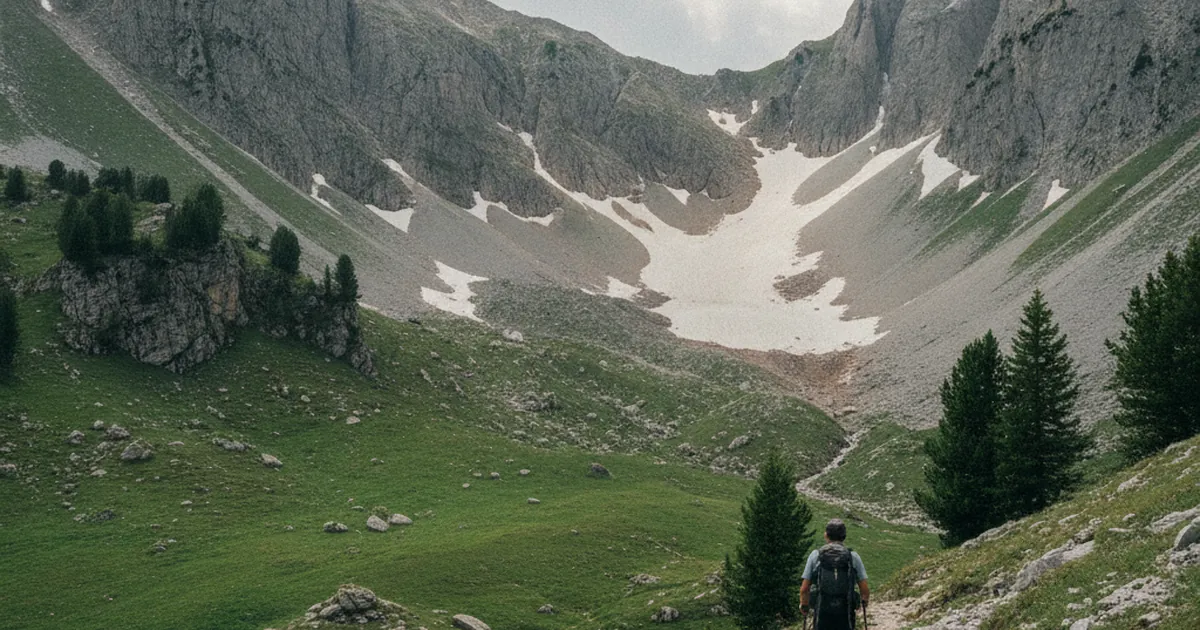
It's mid-June, you're planning a high-altitude hike and you come across recent photos showing a gully still heavily blanketed in white. Nothing unusual: some spots hold snow until late summer, sometimes beyond. These late-season snowfields are not a minor footnote. They can block a trail, send your feet sliding, or become genuinely dangerous on a steep slope. Knowing where they hide and how to cross them safely is a fundamental skill for anyone looking to hike in Haute-Savoie.
Why snow survives into July
A late-season snowfield is simply winter snow that hasn't melted yet by early summer. Several factors help it hold on.
Aspect is the first one. North-facing slopes get little direct sun: they build up deep snowpack in winter and release it slowly. Gullies oriented northeast or northwest behave the same way. South-facing slopes clear far earlier. Altitude matters too: above a certain elevation, temperatures stay cool even in June.
Topography does the rest. Funnel-shaped gullies concentrate drifting snow and shelter it from wind. Hollows and cliff bases accumulate deposits that direct sunlight never fully reaches. After a heavy winter, snowfields are more numerous, thicker, and last longer. A big snow year can still be read in the terrain well into July.
How to spot them before you head out
A few habits are enough to avoid unpleasant surprises.
- Check recent trip reports. Hiking platforms publish dated feedback from other hikers. A GPS track uploaded last week is worth more than any theory.
- Look at photos. Apps and specialist forums often include recent images from the field. A gully full of snow in a photo from five days ago is likely still the same.
- Zoom in on the map. Digital topographic maps give you slopes and orientations. An itinerary that crosses a col on the north side after a long south-facing ascent deserves a second look.
- Ask the locals. Tourist offices, forest rangers, and refuge wardens are well-informed about early-season trail conditions. A quick phone call can save an entire day.
Crossing a snowfield without putting yourself at risk
A flat snowfield on a wide path is straightforward. A sloped one on a gully dropping toward rocks is another matter.
- Assess the angle. If the slope exceeds roughly 30 degrees and you don't have crampons, caution is warranted. A fall on hard snow can carry you a long way.
- Read the surface. June snow is often transformed: a hard crust in the morning that softens through the afternoon. Early morning on steep snow means easy sliding; mid-day means more post-holing but better grip.
- Work the edges. Snow retreats from its margins first, leaving a strip of bare ground on either side. That strip is usually the safest line, even if it's less direct.
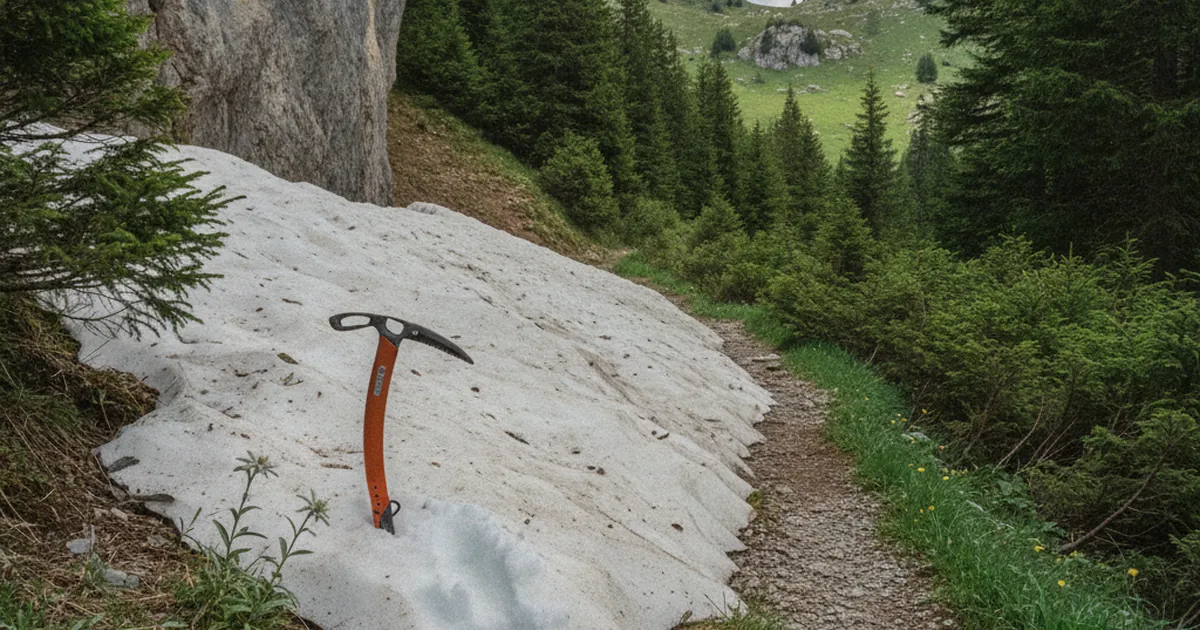
- Gear up properly. A trekking pole helps with balance. Lightweight crampons (microspikes) are a serious option once the angle increases. An ice axe is reserved for alpine routes where a real slide risk exists.
- Turn back if in doubt. A snowfield blocking a steep gully without the right equipment is a good reason to retrace your steps.
Where to find them in Haute-Savoie
Late-season snowfields are not exclusive to the highest massifs. They appear wherever altitude and aspect combine in their favour.
In the Pays du Mont-Blanc area, high-altitude routes frequently encounter persistent snow in June and July. Gullies descending from ridgelines toward the north hold their deposits long after south-facing slopes have dried out.
In the Giffre valley and the Chablais, north-facing slopes accumulate snowfields that hikers regularly cross well into summer. Routes like the Lac de la Vogealle via the Crêt or the Pointe de Ressachaux pass through high-altitude terrain where snow can linger until July. In the Aravis and Bornes massifs, north-facing cirques hold their snowfields well past the solstice.
What to keep in mind every June
June is the month when the mountains reclaim the season without having quite finished tidying up. Conditions shift quickly from one slope to the next. The evening before a hike, a run through recent trip reports will give you a far sharper picture than any guidebook. Also let someone know your itinerary: if a snowfield forces you to turn back, they will know where to look.
Late-season snowfields are part of the June landscape in Haute-Savoie. They are not an anomaly: they are the mountain finishing winter at its own pace. With good preparation, the right information, and the right gear, what could be an obstacle becomes an extra layer of experience. Check conditions before you leave, match your equipment to what you will actually cross, and keep a fallback option in mind at all times.