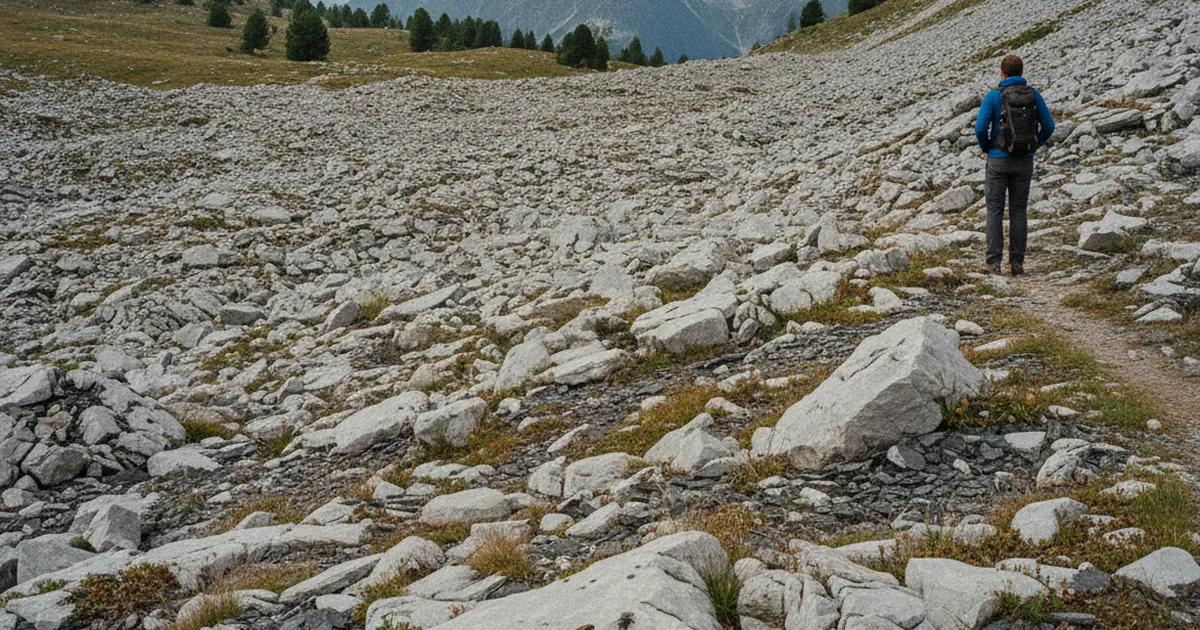
When you cross a scree field, you might feel you are walking through a dead and hostile landscape. Loose rocks, no shade, unstable ground, no obvious sign of life. Yet this environment, which ecologists call a talus or scree, actually harbours a discreet but very real fauna and flora. You just need to know where to look.
An unstable substrate that is still a substrate
A scree field is primarily the result of erosion. Freeze-thaw cycles crack the parent rock into blocks of all sizes, which slowly slide downhill. This continuous movement, sometimes imperceptible and sometimes sudden, gives the habitat its distinctive character.
Between the blocks, in the gaps, dust, fine soil and organic matter accumulate. This microscopic material, sheltered from the wind and retaining moisture, provides enough substrate for certain plants: not all plants, but those capable of tolerating instability, extreme temperatures and surface drought.
Plants that found a way
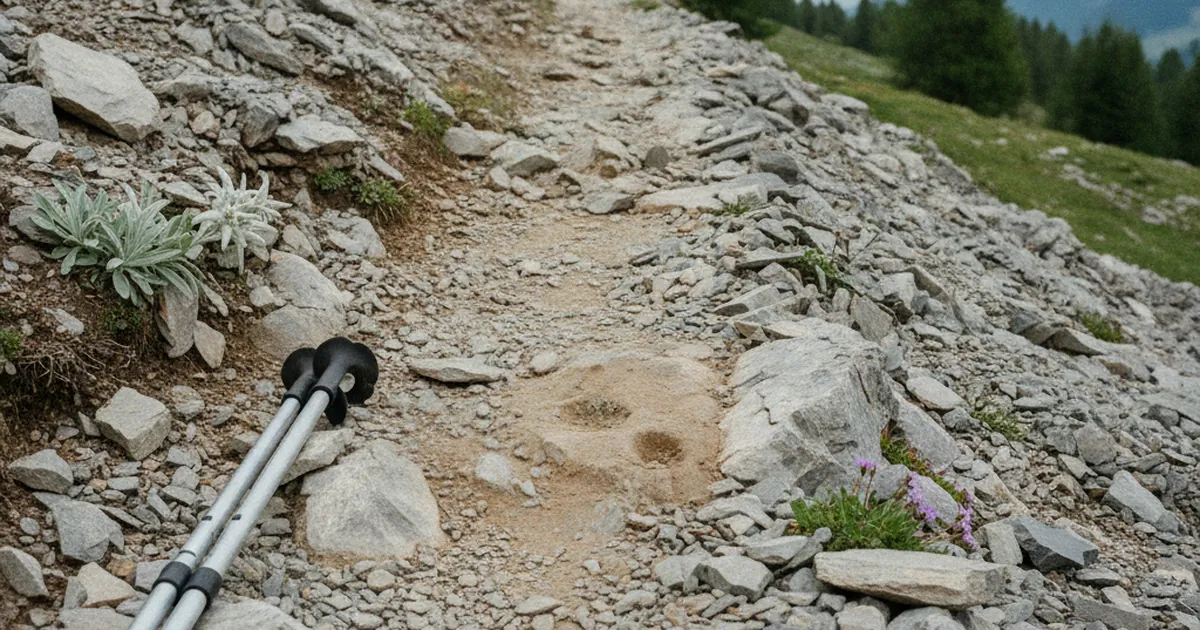
Alpine toadflax (Linaria alpina) is one of the great scree specialists. Its small violet and yellow flowers appear as soon as the snow melts on high-altitude scree. Its long, flexible taproot allows it to follow the movement of the blocks without tearing.
French sorrel (Rumex scutatus) colonises more stable patches. Its shield-shaped leaves, thick and slightly acidic, are easy to recognise once you know what to look for. You will find it frequently in the limestone screes of the Savoyard pre-Alps.
Saxifrages, represented by many species in the Alps, are other colonisation champions. Their tight cushions hold soil in place, stabilise the ground locally and create micro-niches for other species. This slow but continuous process paves the way for denser vegetation over time.
Wildlife: warmth and discretion
Stone blocks absorb the sun's heat and release it gradually. For reptiles, this thermal property is essential. Common wall lizards and viviparous lizards readily frequent south-facing screes, where they can regulate their body temperature effectively.
The wallcreeper is another emblematic resident. This bird with its spectacular red and white wings moves across cliffs and rocky screes in search of spiders and insects lodged in the crevices. Spotting one on a hike is a genuine treat.
Among insects, scree fields shelter beetles adapted to life between the rocks. Some ground beetle species are strictly tied to this habitat, making them valuable bio-indicators for alpine ecosystem health. Stoats and snow voles also venture there, using the natural tunnel network formed by the blocks to move under cover from predators.
Where to observe scree habitats in Haute-Savoie
Scree fields are common in the rocky areas of the Chablais and Faucigny. The hike to the Rochers de l'Aigle takes you through several such zones, with a good variety of adapted plants visible from late spring onwards.
Around Bellevaux, the limestone slopes expose their scree after snowmelt. The Tête de Bostan via the old gold mines trail, in the Giffre valley, also offers fine examples of high-altitude scree with clearly visible pioneer vegetation in summer.
The Chablais area has many scree fields on its limestone slopes, often clearly visible from marked trails without even leaving the path.
Crossing a scree field without damaging it
Despite appearances, scree fields are fragile environments. A colony of pioneer plants can take decades to establish. A single crossing off the marked trail can destroy it in a few steps.
A few simple habits help protect them:
- Stay on cairned or marked routes where they exist.
- Avoid turning over rocks: each block is a micro-habitat.
- Do not pick plants, even the most accessible ones.
- In a group, walk in single file rather than spreading out.
Scree stability is also a safety matter. Blocks can slip underfoot, especially on steep slopes. Test each foothold before committing your full weight.
Next time you cross a scree field, take a moment to stop. Look between the blocks. Watch the small violet flowers, the lizards darting away at your approach, the red-winged bird climbing the rock face. This environment you thought empty is in reality a discreet refuge for species that have mastered adaptation to extremes. It is one of the hidden beauties you discover when hiking in Haute-Savoie.