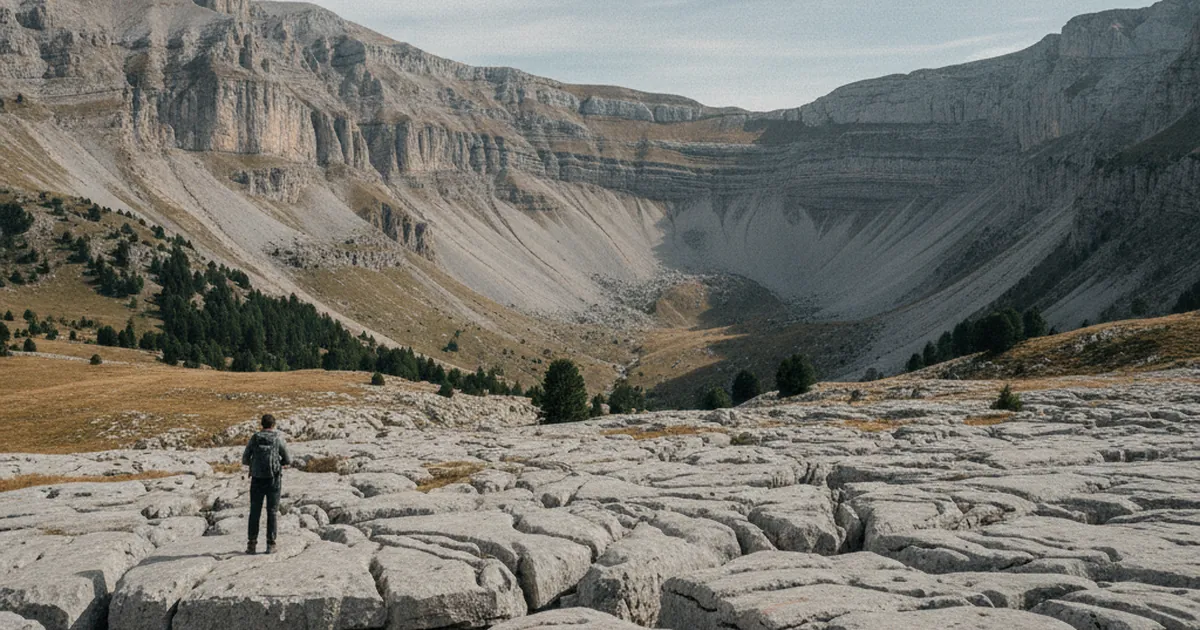
Few areas in the Northern French Alps match the geological singularity of the Giffre plateau. As you travel up the Giffre valley from Taninges toward Samoëns and Sixt-Fer-à-Cheval, the landscape gradually shifts in character: limestone takes over the bedrock, shaped by water and ice over millions of years. Karst, lapiaz, glacial cirques: these aren't just scientific terms. They describe what you're walking on when you explore the trails of Haute-Savoie.
Limestone: the rock that defines everything
Geology starts with the bedrock. While the Mont Blanc massif next door is built on granite, and the Aravis alternates between shales and limestone, the Haut-Giffre is firmly limestone country. This single fact changes everything: the way water drains, the shape of slopes, the color of cliffs, and the plants that manage to grip the terrain.
Limestone is a soluble rock. Rainwater, slightly acidic, dissolves it slowly but steadily over thousands of years. The result is a set of landforms you won't find in a granite mountain range. This type of landscape is called karst, named after a region in Slovenia where it was first studied systematically.
Karst: an underground geography
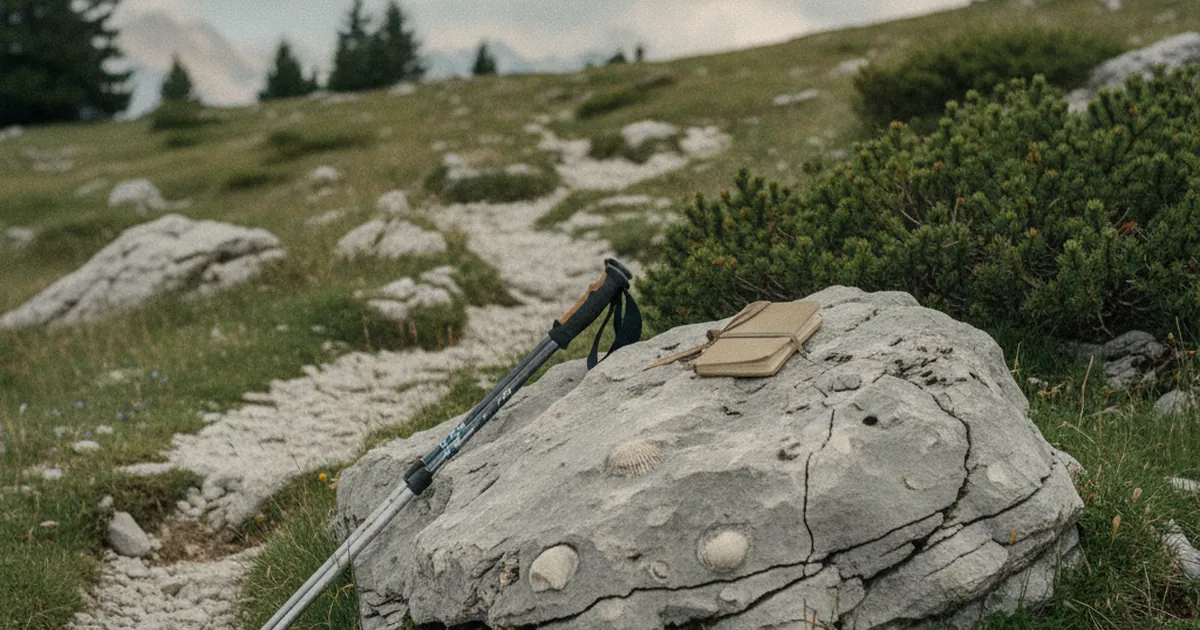
The defining feature of karst is a hidden hydrology. Rainwater seeps into cracks in the limestone, carves underground channels, travels through the rock, and re-emerges elsewhere as springs. In the Giffre plateau, this cycle is visible if you know what to look for: streams that vanish into the ground, springs that burst from cliff faces, enclosed hollows (dolines) scattered across the alpine meadows.
This underground system is also responsible for the gorges. The Gorges des Tines, between Samoëns and Sixt-Fer-à-Cheval, were cut vertically into karstic limestone by the Giffre river. The sheer walls, the pot-holes scoured by the current, the orange-tinted rock: all of it is the work of water on limestone, over geological time.
Lapiaz: the skin of the mountain
As you climb to altitude in the Haut-Giffre, you'll often encounter stretches of bare rock grooved with channels and split by deep fissures. These are lapiaz (or lapiés in French). They're exposed limestone surfaces etched by meltwater and rain over centuries, forming where soil and vegetation have been stripped away and the rock faces the elements directly.
Walking on lapiaz takes care: the surface is uneven, sometimes sharp-edged, and the fissures can be deep. But they're fascinating to look at up close. Each groove tells you where water once flowed; each crack marks a weakness in the rock that water found and widened. Around Verchaix and on the ridges between Morillon and Samoëns, good examples appear on several high-altitude routes.
Glacial cirques: memory of the ice ages
The Cirque du Fer-à-Cheval, near Sixt-Fer-à-Cheval, is one of the most spectacular glacial cirques in the French Alps. This horseshoe of limestone walls, fed by waterfalls cascading from the snowfields and peaks above, is the product of glacial erosion over vast timescales. Quaternary glaciers carved out this basin by plucking rock from the headwalls, then retreated, leaving this wide amphitheater open to the valley below.
What sets it apart from the granite cirques of the neighboring Mont Blanc massif is the rock itself. Limestone walls appear lighter, more veined, sometimes layered in sheets. Waterfalls trace white lines down grey-blue faces. For a hike that takes you directly into this karstic high-mountain world, the route to Lac de la Vogealle via the Crêt is a strong choice.
A landscape worth reading
Understanding the geology of the Giffre plateau changes the way you see the mountain. When you cross a lapiaz field, you picture water working on rock over millennia. When you walk through the Gorges des Tines, you feel the force of a river sawing through vertical stone. When you look up at the walls of the Cirque du Fer-à-Cheval, you read the imprint of ice-age glaciers.
This territory stands clearly apart from the Pays du Mont-Blanc, where granite dominates, or from the Bauges, with their rounded forested hills. Here, limestone imposes its own aesthetic: pale, vertical, open, karstic. The Giffre plateau isn't just a beautiful hiking valley. It's an open-air geological classroom, where the landscape itself is the lesson.
Want to explore it for yourself? The Haut-Giffre has trails along the gorges, up to karstic high pastures, and deep into glacial cirques. Take time to look at the rock beneath your feet. It has a long story to tell.