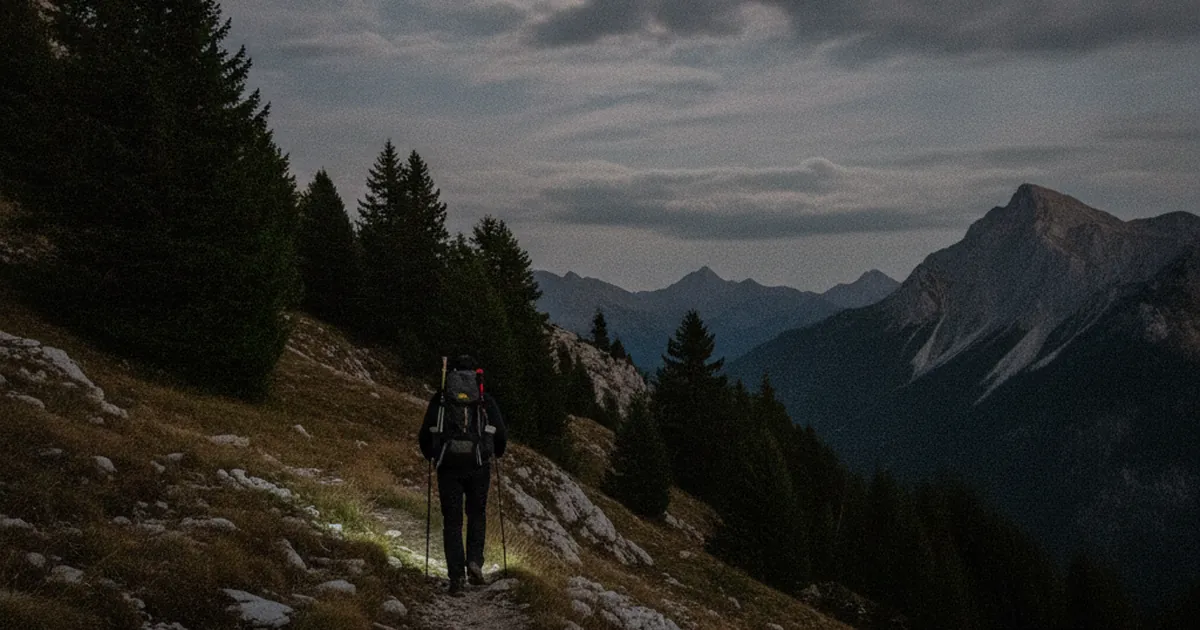
Night hiking under the moon is one of those experiences many hikers picture but few actually attempt. That is a shame, because a well-prepared nocturnal outing offers something genuinely unique that daylight simply cannot replicate. That said, the mountain at night is not the same hike shifted to different hours: it follows its own rules, and a few mistakes can turn a beautiful evening into a complicated situation. So is moonlit hiking a good idea? Here is what you need to know before you try.
The genuine appeal of the mountain at night
There is the silence, for a start. In summer, trails across the Haute-Savoie are busy with hikers from early morning onward. At night, you hear nothing but insects, wind in the larches, and perhaps a chamois scrambling down the slope. It is a completely different way of moving through a landscape you may already know from daytime walks.
Then there is the quality of moonlight. On a clear night, a full moon provides enough light to follow a well-marked path without a headlamp. Slopes read differently, shadows create unfamiliar contrasts across the alpine meadows, and the sky reveals a depth that daytime glare conceals. Something shifts in the way you perceive a landscape when the sun is no longer there to flatten everything.
And the coolness. At the height of August, setting out in the late evening means avoiding the heat that accumulates on sun-facing slopes during the day. For those who prefer cooler temperatures and easier ascents without overheating, that is a genuine practical advantage.
What night actually changes
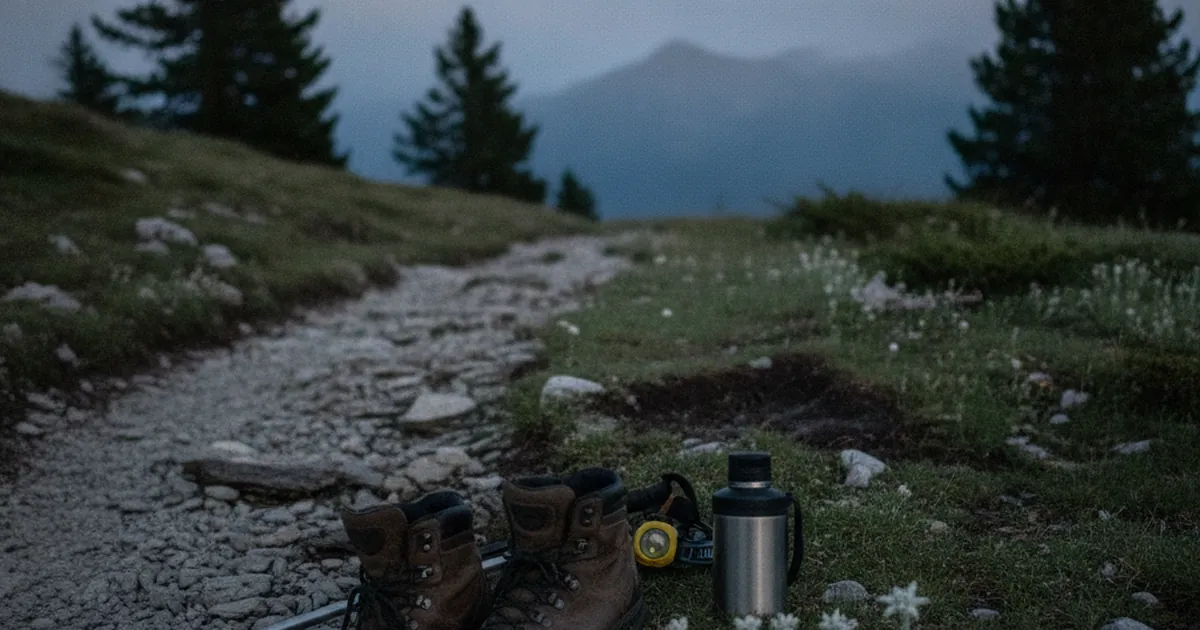
But the appeal should not be over-romanticised. Night in the mountains comes with real constraints. Terrain readability is the first one: even with a good headlamp, you see less far, you miss subtle slope changes, and small cairns or ground markings are easy to overlook. On a route you do not already know, losing the path becomes a real risk.
Then there is the cold. In the mountains, even in August, temperatures can drop ten to fifteen degrees between mid-afternoon and two in the morning. If you leave in a t-shirt because it feels warm at the start, you may be in mild hypothermia two hours later. The mountain has no patience for equipment compromises.
Fatigue matters too. A night hike that starts in the evening usually follows an already active day. Alertness drops, decision-making degrades, and missteps happen more easily on rocky or dew-wet terrain.
The conditions worth meeting
A successful night hike is not improvised. A few conditions are non-negotiable:
- A full moon, or the two nights around it: that is the window when natural light is sufficient to complement your headlamp.
- A clear sky: clouds and fog produce absolute darkness and remove all visual reference points.
- A route you know, or a simple one: a well-marked loop with no technical sections and no snowfields.
- A partner or a group: alone at night in the mountains, even a minor incident becomes complicated quickly.
- A stable forecast until your return: a mountain thunderstorm at night is not an anecdote, it is a serious situation.
Equipment you cannot skip
A headlamp is essential, even under a full moon. Cloud cover can roll in within minutes and leave you in complete darkness. Bring spare batteries or a fully charged rechargeable lamp. A small backup torch in the pack is worth the extra weight.
Warm layers are a must: a light down jacket or thermal windshell, gloves if you are heading to higher elevations. In August this feels unnecessary at the start. At two in the morning near a summit, you will be glad you brought them.
A phone with the GPS track downloaded offline, a power bank, a basic first-aid kit, enough water (water points that are easy to spot by day are not always locatable in the dark), and a survival blanket round out the essentials.
Where to start in the Haute-Savoie
For a first night outing, stick to routes that are short, straightforward, and that you already know by day. The Annecy area and the Bauges massif, reachable through the Annecy-Bauges valley, offer several options with the right profile: clear paths, moderate elevation gains, and a quick return if needed.
The Crêt de Châtillon, starting from Leschaux, is a solid entry point. A very easy loop with clear waymarking that arrives at a summit with an open view over Lake Annecy and the surrounding ranges. Under a full moon, that panorama takes on an unexpected quality. Closer to the town of Annecy, the Sainte-Catherine loop from Seynod is another well-marked circuit well suited for a first night hike without straying too far from town.
The principle for hiking in the Haute-Savoie at night is the same as by day: match your ambition to your preparation level. A first successful night hike does not start on an ambitious summit. It starts on a familiar trail, with the right gear, in the right conditions. When a full moon, a clear sky, and a known path all line up at once, all that is left is to go.