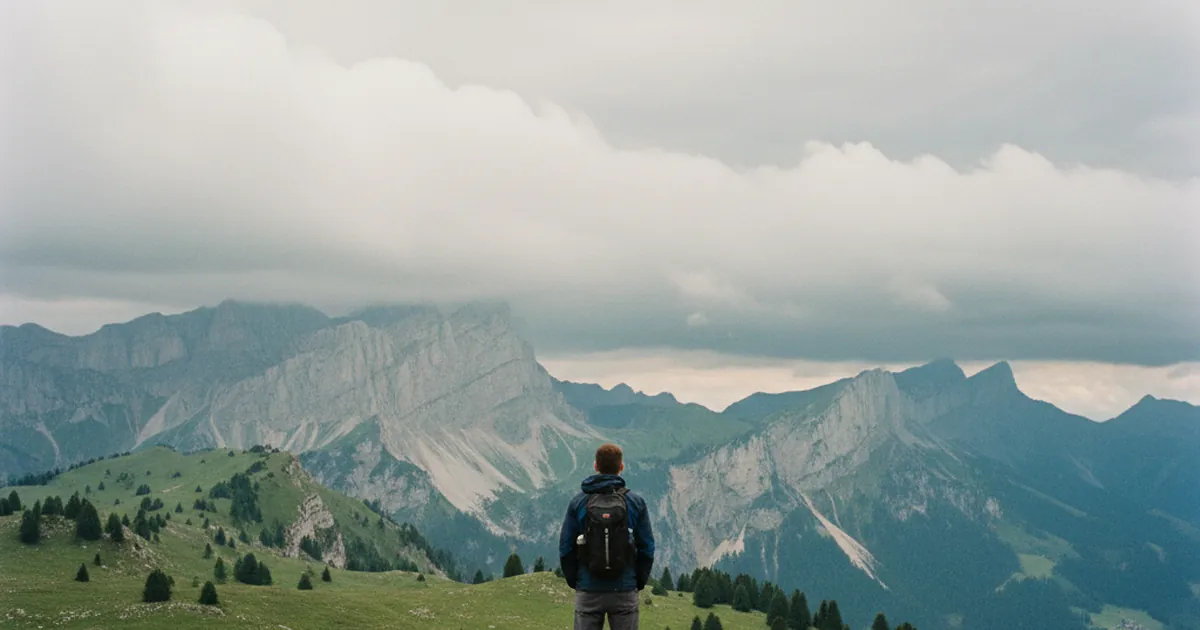
Every summer, hikers get caught in mountain thunderstorms. Not because they are reckless, but because they didn't know the warning signs. A clear blue sky at dawn guarantees nothing for the afternoon: at altitude, weather can turn violent in under thirty minutes. Before heading out hiking in Haute-Savoie, learn to read what the sky is telling you.
Reading the Sky Before It Turns
Alpine thunderstorms build over several hours. The signals are visible to the naked eye if you know what to look for.
- Morning cumulus clouds: if by 9 or 10 a.m. white clouds are building fast and gaining height, take note. A sky that stacks up quickly in the morning often means a storm by early afternoon.
- The cumulonimbus: the anvil cloud, dark and flat at the base, white and cauliflower-shaped on top. The moment you spot one, even on the distant horizon, assume it can reach you.
- A darkening horizon to the southwest: most storms in Haute-Savoie arrive from that direction. A dark wall there deserves your full attention, even if the sky above you is still blue.
- Halos around the sun or moon: spotted the evening before or early morning, a solar or lunar halo signals high-altitude moisture and is a reason to stay alert throughout the day.
Ground-Level Warning Signs
When danger is imminent, the terrain itself alerts you. These signs mean the storm is very close or you're already in a lightning-strike zone.
- The smell of ozone: a sharp, electric smell in the air means discharges are occurring nearby, sometimes before you hear any thunder.
- Hair standing on end or tingling skin: absolute emergency. You are inside the electric field of an imminent lightning strike. Leave that spot immediately.
- Buzzing or vibrating gear: if your trekking poles, watch, or GPS starts humming for no reason, drop metallic gear and move away at once.
- A sudden temperature drop with a rising wind: a sharp chill in just a few minutes typically precedes the storm cell and is usually your last warning before lightning arrives.
Preparation Before You Leave
The best protection against a mountain thunderstorm is not being caught in one. A few simple habits dramatically lower your risk.
- Check the mountain weather forecast: Météo-France publishes dedicated mountain bulletins with specific storm-risk windows. Read them the evening before and on the morning of every outing, not just a generic weather app.
- Start early: summer convective storms typically build between 1 and 5 p.m. If you're targeting a ridge or summit, leave at dawn and be at the high point before noon.
- Plan an escape route: before leaving, identify refuges and lower terrain where you can retreat quickly. In the Chablais and across the range, loop routes often give you a shortcut option if conditions change.
- Turn back without waiting: if you see the signs coming in, don't convince yourself it will pass. Giving up a summit an hour early rather than being stranded on a ridge in a full storm is never a decision you'll regret.
Places to Avoid During a Storm
Some spots attract lightning; others create a different but equally real danger.
- Ridges and exposed summits: you become the highest point around, which attracts strikes. On routes like Boucle du Reray that cross open ridgelines, start descending the moment the sky starts building.
- Isolated trees: a single tree in an open field is a natural lightning rod. Keep at least 30 metres away.
- Shallow caves and rock overhangs: ground current enters at the opening and exits the other side. Taking shelter under a shallow overhang can be fatal. If you shelter under rock, go deep into a genuine cavern.
- Lakes and riverbanks: water conducts electricity. Leave the lakeshore or stream bank as soon as the storm approaches.
- Via ferrata cables and fixed metallic gear: fixed metal conducts lightning over long distances. Don't start a via ferrata if the sky looks threatening, and if you're already on one, get off it fast.
If the Storm Catches You Out
Sometimes, despite all precautions, the storm arrives before you can reach shelter. The right reflexes reduce your risk.
- The lightning crouch: crouch low on the balls of your feet, feet together, hands over your ears to protect your eardrums, head down. Don't lie flat: ground current travels horizontally, and a flat body offers the maximum contact surface.
- Spread your group out: keep 10 to 15 metres between group members so a single strike doesn't bring everyone down at once.
- Find flat or gently hollow ground: avoid the highest point (ridge, isolated rock) and the lowest (ravine bottom). A gentle slope or shallow depression on mid-terrain is your best option.
- Put metallic gear at a distance: poles, pack frames, via ferrata equipment. At least 5 metres from your body.
Reading the sky, anticipating the turn, and knowing what to do when things go wrong: that is the mountain skill that truly matters. Physical fitness and expensive gear count for nothing if you can't read the weather. Whether you're out on Les 3 Bornes, exploring the trails around Bellevaux, or anywhere else in Haute-Savoie, summer storms are part of the landscape. Respecting them is what lets you keep coming back.