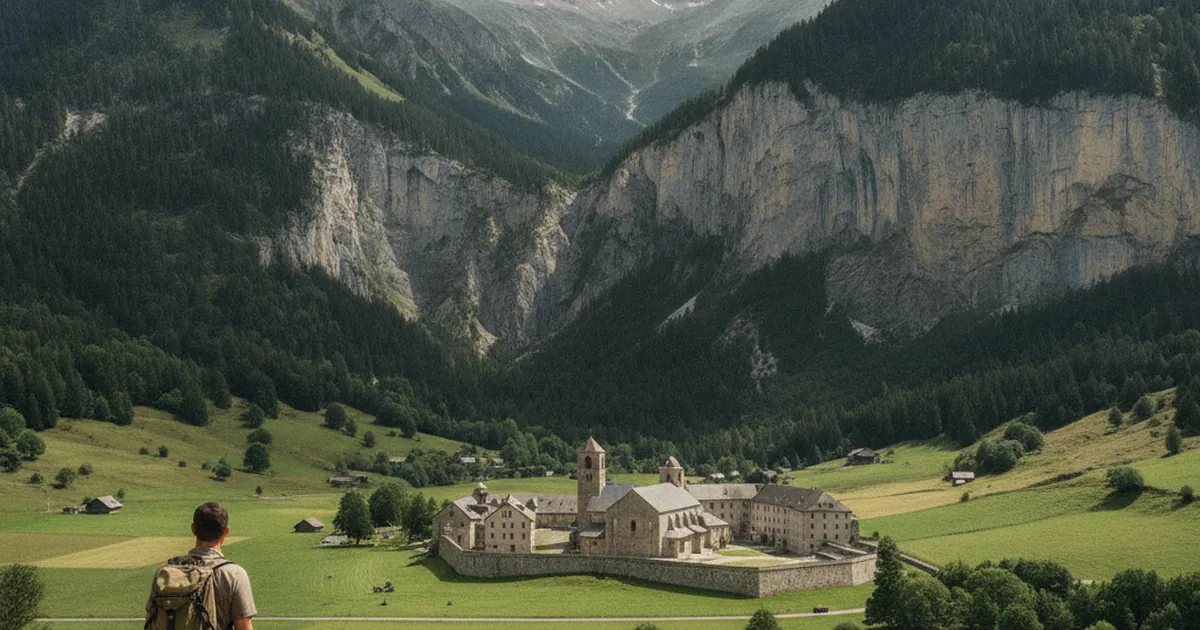
Sixt-Fer-à-Cheval is not a village you pass through. It's a terminus. The road ends here, deep in the Giffre valley, and beyond that it's trails, rock, and silence. This village in Haute-Savoie packs an exceptional architectural heritage around its Cistercian abbey, a top-tier nature reserve, and hiking trails that could fill several days. If you want to explore the mountains of Haute-Savoie while combining nature with history, Sixt is worth a long stop.
The Cistercian Abbey: a stone memory
It's the first thing you notice when entering the village. Sixt Abbey, founded in the 12th century by Cistercian monks, has shaped this place for over eight centuries. The abbey church is still standing: sober in form, readable in its architecture. Its bell tower, sculpted capitals, and even stonework speak of careful craftsmanship. The abbey is listed as a historic monument.
The church is free and open to visitors. Inside, you find the Cistercian tradition in full: absolute simplicity, no superfluous ornament, sparse but precise light. The partially preserved cloister forms a quiet square where vegetation has made itself at home. You can spend a good half-hour there doing nothing in particular, which is already quite a lot.
What sets this heritage apart is how it fits into the living fabric of the village. The abbey isn't fenced off behind rails or put under glass. It's part of the daily landscape: people walk past it heading to the bakery or to reach the trailhead. That casual familiarity is a form of respect many listed monuments have long since lost.
During the French Revolution, the monks were forced to leave. Part of the monastic buildings was sold or repurposed. The church survived. Successive restorations have kept the building in decent shape, and the abbey remains a strong marker of Sixt's identity.
The village: simplicity at the end of the road
Beyond the abbey, Sixt-Fer-à-Cheval is an ordinary Savoyard village, and that's meant as a compliment. Houses have the wide overhanging roofs typical of mountain construction, barns sit next to guesthouses, and the Giffre runs below with colors that shift by season. Life here revolves around farming, tourism, and mountain sports.
The village's position at the end of the road explains a lot of its character. People who come to Sixt choose to come to Sixt. There's no through-traffic, no accidental visitors. That natural selection gives the place a quietness that many Alpine villages and resorts lost a long time ago.
In summer, terraces fill up in the evening. In winter, the village pulls inward. Various accommodation options make Sixt a workable base for several days, which is probably the best way to enjoy it. The village page lists all the marked trails starting from Sixt, from easy family loops to full alpine crossings.
The Cirque du Fer-à-Cheval, right next door
A few kilometers from the village, the Cirque du Fer-à-Cheval is one of the most impressive natural sites in the French Alps. This vast horseshoe-shaped limestone wall gives rise to numerous waterfalls during snowmelt or after storms. The sight is often jaw-dropping, sometimes loud, always imposing.
The site is protected by a national nature reserve. Car access is regulated in summer, with shuttle services running from the village. On foot, the path from Sixt to the cirque follows the Giffre and is already a pleasant walk in itself. Families with young children can turn back halfway without feeling short-changed.
The site draws crowds in July and August. If you want to avoid peak hours, heading out early in the morning or in the late afternoon makes a real difference. The protected status and well-organized access keep the experience manageable even during busy periods.
Hiking from Sixt
The village is a launchpad for hikes at very different levels. Trails range from gentle discovery loops suitable for families to technical routes that take a full day and require solid fitness.
The Bout du Monde circuit is a moderate hike starting from the Frénalay chalets. It leads through wild gorges where the path runs close to the stream. Scenic, accessible, memorable. A strong choice for a first day in Sixt, or for a straightforward outing after a long drive.
For those wanting to go higher, the Praz de Commune hike from Sixt is a more demanding route. The start is from the village itself, the ascent is long and tiring, but the views over the valley and the alpine pastures make the effort worthwhile. Plan for a full day and stable weather.
Getting there
Sixt-Fer-à-Cheval is reached by following the Giffre valley from Samoëns, itself accessible from Taninges or Cluses. In summer, shuttles connect Samoëns to the Cirque du Fer-à-Cheval. By car, the road from Cluses is fast and well-maintained. Parking is available in the village and at the entrance to the nature reserve.
Sixt isn't on the way to anywhere else, and that's precisely the point. For those who make the trip, the village offers a rare balance of Cistercian heritage, preserved nature, and mountain authenticity. The abbey is the symbolic gateway. The surrounding territory does the rest of the work.