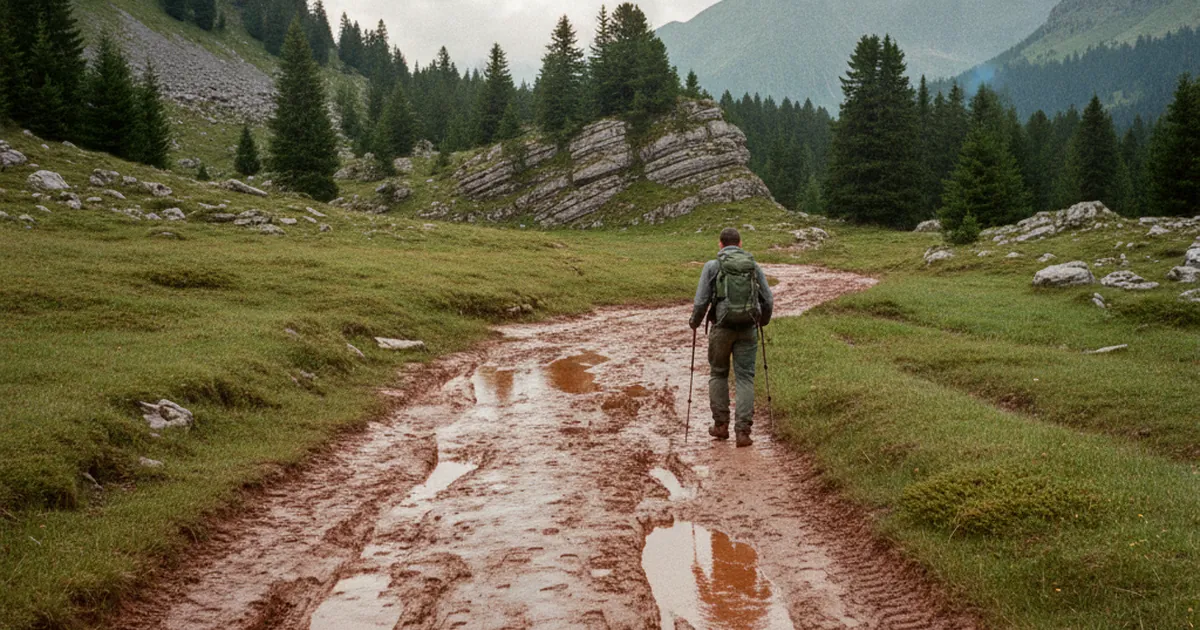
You've checked the forecast, you know the area, and still. A marked trail, one misstep, and suddenly you're halfway down in the mud with a screaming knee. Wet clay is one of the most treacherous surfaces a hiker can encounter. Understanding why it's so slippery, and how to handle it, is just as important as reading a map when hiking in Haute-Savoie.
What exactly is clay?
Clay isn't a rock type like limestone or granite. It's a mineral that forms in very thin sheets, the result of slow alteration of feldspar-rich rocks over thousands of years. Clay particles are less than two microns across. To the naked eye, it looks like fine soil, often greyish or brownish, with a slightly greasy feel when wet.
In Haute-Savoie, clay soils are mostly found in geological transition zones, where erosion has broken down shale or certain sedimentary rocks. Valley floors, wooded slopes, and north-facing hollows are the places to watch after rain.
Why does it become so slippery after rain?
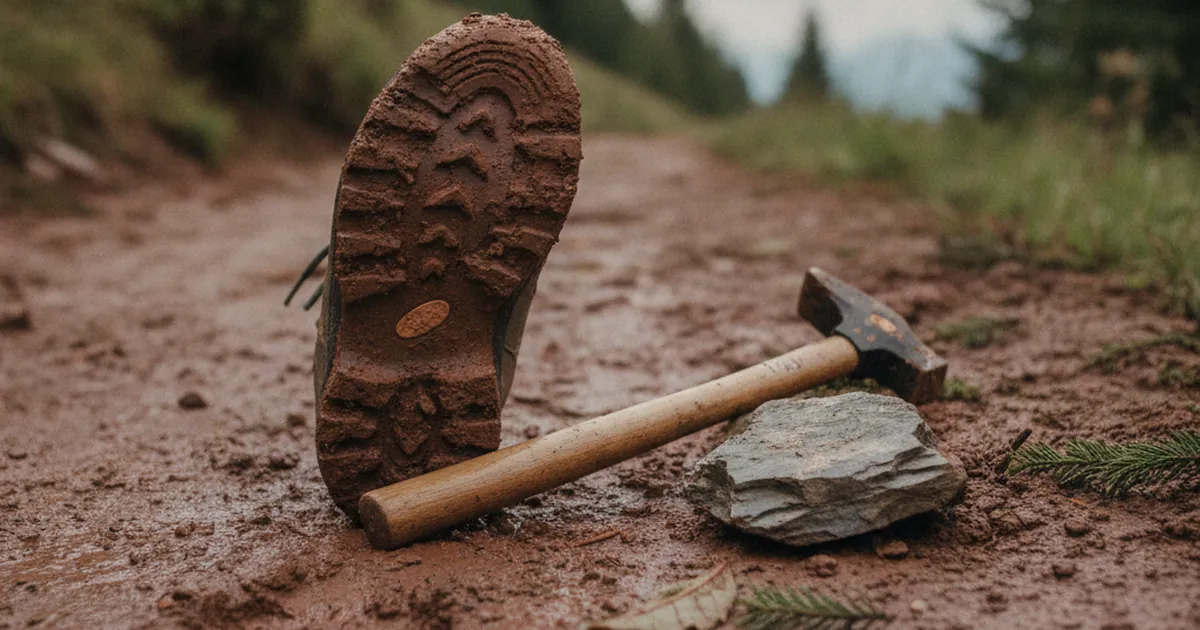
Everything comes down to clay's layered structure. These thin mineral sheets absorb water between their layers, but can only retain so much of it. The rest forms a liquid film on the surface, an almost oily layer that acts as a lubricant between your boot and the ground.
In practice, a dry clay soil has a friction coefficient of around 0.5 to 0.7 depending on the terrain. After rain, that can drop to 0.1 or 0.15: comparable to lightly wet ice. No boot grips well in those conditions, even the most aggressive trail-running lugs.
What makes it worse is that water doesn't evaporate quickly from clay. A trail that got soaked the previous day can stay slippery for 24 to 48 hours, even once the sun returns. Drainage is slow because the fine particles clog their own channels.
Where is the risk highest in Haute-Savoie?
Not all trails are equally affected. Rocky, limestone, or shale paths dry quickly and regain grip as soon as the surface is dry. The danger concentrates in transition zones: low-altitude forests and intermediate slopes.
In the Giffre valley, forest trails around Taninges and Mieussy cross schist and clay-rich terrain that turns particularly sticky after rain. The Forêt de Petetoz via la Ramaz hike is a good example: a pleasant, well-marked trail that can become a slide under the trees the moment moisture sets in.
As a rule, areas below 1,500 metres, where vegetation is dense and the ground less rocky, carry the most clay. Higher up, alpine terrain takes over: rocks, scree, and limestone that dry out far more quickly.
How to adapt your walking technique
Changing trail after rain isn't always an option. Here's how to reduce the risk:
- Shorten your stride. Short, frequent steps with a low centre of gravity reduce the chances of losing balance.
- Plant poles at an angle. Slightly backward, to brake rather than block suddenly. A vertical pole planted in clay gives way without warning.
- Walk the edge of the path. Grass and roots at the sides of a trail often offer more grip than the compacted, polished centre.
- Avoid tight turns on descents. Slips happen most often during rapid direction changes on a slope.
- Test each step on steep ground. Place your foot gently, check the hold, then transfer your weight. It's slow going, but it beats falling.
Gear: what helps and what doesn't
Vibram-soled boots with deep, widely spaced lugs perform better than models with narrow, closely packed treads. Clay builds up between the lugs fast, and if they're too tight together, you end up walking on an effectively smooth sole. Clear them regularly with a stick or stone as you go.
Low gaiters are useful for keeping mud out of your boot, but they don't change grip. Microspikes and lightweight crampons are designed for ice or snow, not soft wet soil, so don't expect them to help here.
Telescopic poles, properly adjusted, make a genuine difference. They spread your load across four contact points instead of two, which meaningfully cuts the risk of slipping.
Wait it out, or adapt?
It's worth asking the question seriously. If it rained for more than two hours and your planned route crosses forested slopes, waiting 24 hours isn't weakness. It's good judgement. In the Mont-Blanc area as across the rest of Haute-Savoie, some marked trails become objectively dangerous for several hours after heavy rain.
If you decide to go anyway, scale back the plan: a shorter route, familiar terrain, an early turnaround if things get out of hand. The mountain will be there tomorrow. Wet clay, on the other hand, always has time for the hiker in a hurry.