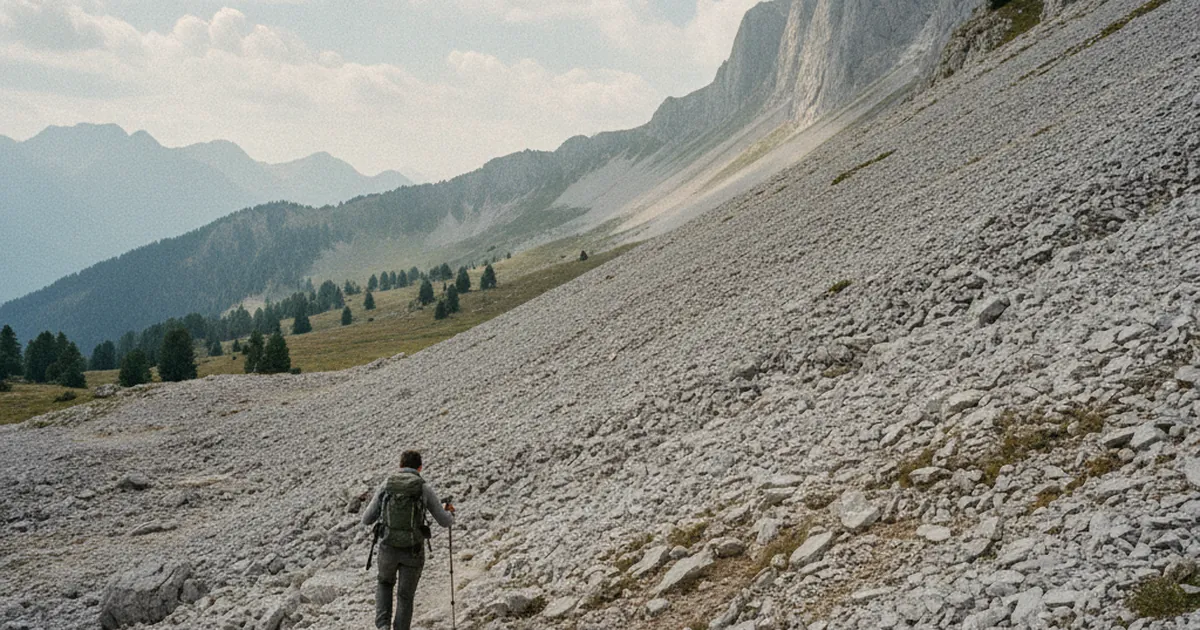
Scree is one of the most unsettling surfaces in hiking: loose, unstable rock with no marked path to follow. In Haute-Savoie, you encounter it almost as soon as you climb above 1,800 metres on mountain routes. The good news is that crossing scree safely is a skill you can learn. A few straightforward principles will get you through without falling, twisting an ankle, or sending a rockslide onto the hikers below.
Reading the scree before you commit
Before stepping onto the first block, stop and look. From the edge, you can already assess the difficulty. Check the dominant size of the rocks: fine scree (shale, gravel) is far more unstable than large boulder fields. Look at the surface colour: dark, wet or lichen-covered stones are much more slippery than pale dry rock. Look for traces of previous walkers: if others have found a line across, it is usually the safest one, since those rocks have already found their balance.
Time of day matters too. Sections in shade can stay wet and slippery for hours after sunrise. If you set off early, plan to cross scree once the sun has had time to dry the surface.
Walking technique, step by step
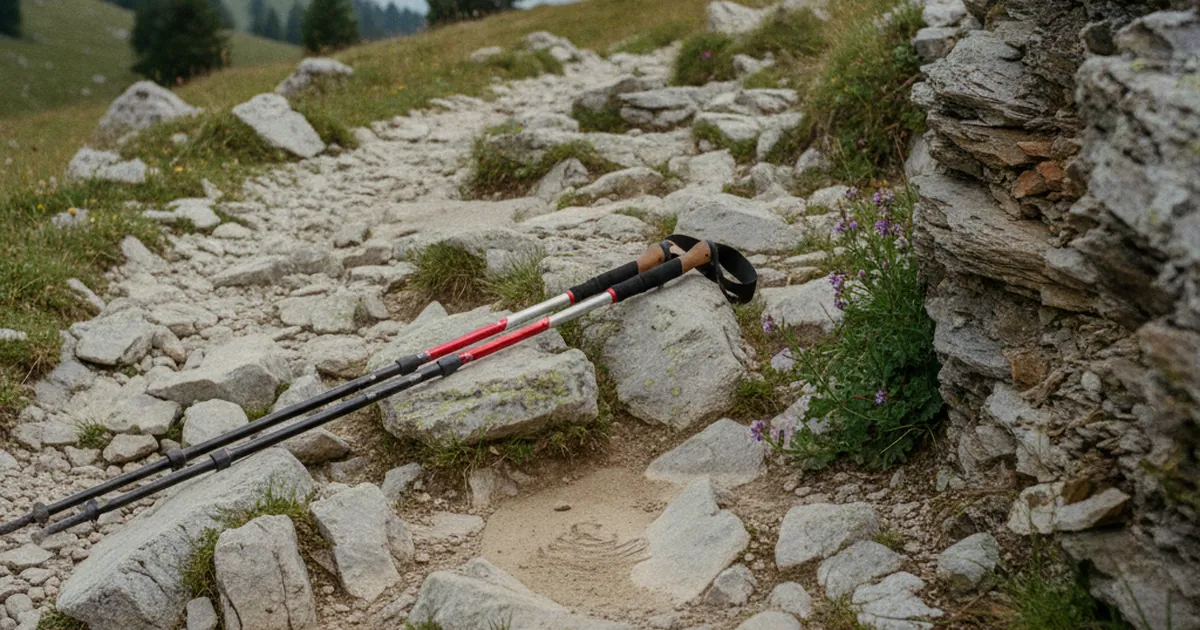
Rule number one: place your foot flat. Not on the toes, not heel-first. A flat foot distributes your weight across a larger surface and reduces the chance of rolling the rock beneath you. Keep your knees bent to lower your centre of gravity and react faster if a block shifts.
Test each rock before committing your full weight to it. A gentle press first to check it does not rotate, then a gradual transfer of weight. Never jump from block to block: the impact can dislodge several stones at once and destabilise the area around you.
Trekking poles make a real difference. Set them slightly longer than on flat ground so you can probe doubtful blocks and give yourself extra balance points. On fine-grained scree descents, a different technique works well: drive your heel in first and let the small stones slide gently under you in a controlled way, almost like skiing. It is less tiring and faster than trying to lock each step in place.
Group safety
Most accidents on scree happen in groups. A stone dislodged by the hiker above can seriously injure the person lower down. The cardinal rule: never line up vertically. On scree, a group crosses in a staggered horizontal line, never in a column with people standing directly above one another.
If a stone breaks loose, shout "rock!" immediately to warn anyone below. Put less experienced walkers in the middle of the group, flanked by people who are comfortable on technical ground. Keep children by the hand on unstable sections.
On a long descent with a large party, wait until the previous section is fully clear before sending the next person across. Rushing is the leading cause of accidents on this kind of terrain.
The right gear
Gear matters as much as technique. A few key points:
- High-ankle boots: they support the ankle and significantly reduce the risk of a sprain when a block rolls underfoot.
- A stiff Vibram-type sole: soft soles lose grip on rock, wet or dry.
- Telescopic poles: essential, especially on descents. Longer going down, shorter going up.
- Helmet: optional on scree away from cliff faces, but strongly recommended under active rockfall zones or early in the season when blocks are less consolidated.
On demanding routes like the Boucle des Hauts-Forts from Morzine, which tops out at 2,445 metres with over 1,250 metres of elevation gain, high-ankle boots are not a comfort choice: they are a safety requirement.
Special conditions
Scree behaves differently depending on the weather. In warm, dry conditions the blocks are generally stable. After even light rain, everything becomes slippery, fine scree especially so. Early in the season, or at high altitude, ice can hide beneath the surface: a block that looks stable may be resting on an invisible layer of verglas.
Fog makes it hard to read the terrain: you lose your overview and your depth perception. If visibility drops sharply while you are on a scree field, stop. Wait it out or turn back rather than pushing through blind on unpredictable ground.
Like any technical mountain skill, confidence on scree comes with practice. Start with gently-angled, manageable fields before taking on steeper or more committing passages. A route like La Pointe de Nantaux from Montriond, with 1,145 metres of elevation gain to a summit of 2,164 metres, gives you solid difficult-grade experience without pushing into the extreme. Whether you are hiking in Haute-Savoie through the Bauges hills or heading for the summits of the Chablais, these reflexes will quickly become second nature.