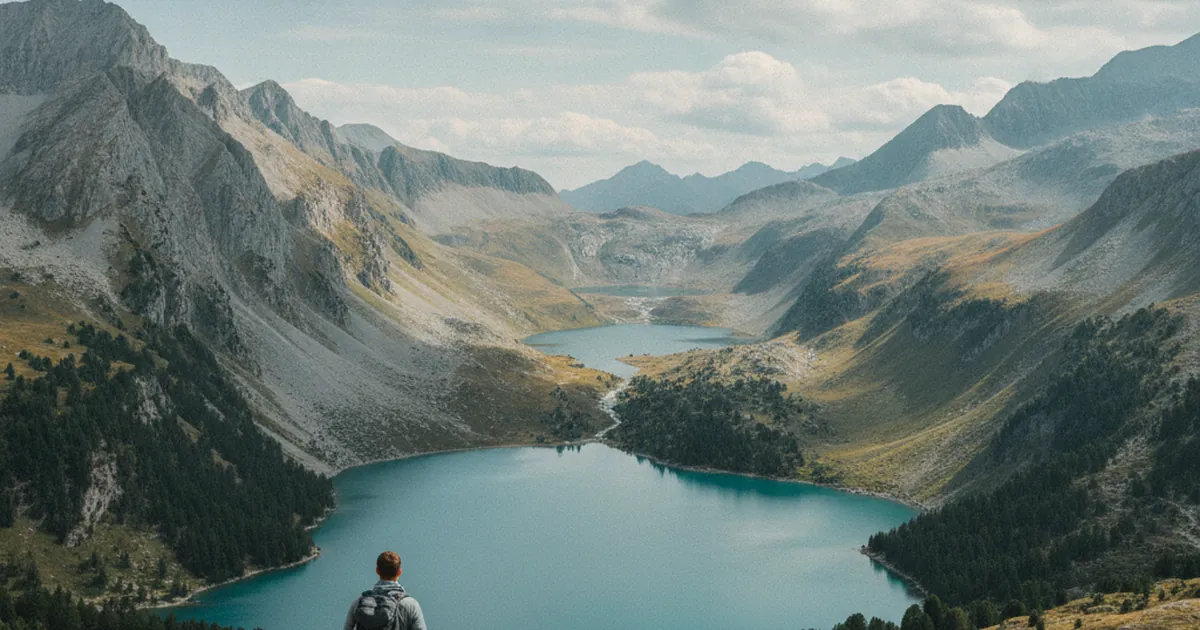
When you find yourself at the edge of a mountain lake in Haute-Savoie, with its clear water and sometimes surprising colour, you are looking at the direct legacy of the great ice ages. Almost all the mountain lakes in this part of the Alps were shaped by glaciers. Understanding their origin means learning to read the landscape beneath your feet. The hikes of Haute-Savoie offer many chances to go and discover them.
Glaciers: architects of the landscape
Around 20,000 years ago, during the last glacial maximum, the Alps were covered by enormous masses of ice, sometimes hundreds of metres thick. These glaciers were never static: moving slowly under their own weight, they scraped and carved the terrain below them. Over thousands of years, this relentless mechanical work shaped the U-shaped valleys typical of the Alps, the steep-walled glacial cirques, the moraines and the rocky hollows. When the ice melted, those hollows filled with water: that is how alpine lakes are born.
Three families of glacial lakes
Geologists generally distinguish three types of glacially formed lakes:
- Cirque lakes: carved into the floor of a glacial cirque by the glacier's erosive action, they are ringed by steep walls and stay very cold even in high summer. In the Giffre valley, Lac de Gers and the Sales area are good examples of this type of formation.
- Moraine-dammed lakes: a moraine is a deposit of rocks, gravel and clay transported and left behind by a glacier as it retreated. When those deposits build up into a natural dam, they hold water back. Lac de Vallon, near Bellevaux in the Chablais, is an accessible example.
- Over-deepened lakes: in certain spots, the glacier eroded the bedrock more deeply than elsewhere, for instance where two ice streams converged or where the rock was softer. These depressions filled with water once the ice retreated and often form lakes that are surprisingly deep relative to their surface area.
Cold, clear, and sometimes coloured
These lakes share several visible characteristics. Their water is cold: even in August, it rarely exceeds 12 degrees Celsius. When a lake is no longer fed directly by an active glacier, the water carries very few suspended particles, which gives it remarkable clarity. The turquoise or blue-green tints you may have noticed are caused by the way light refracts through extremely pure, organically poor water. Lakes still connected to an active glacier receive a milky, silt-laden flow containing fine mineral particles known as glacial flour: the colour there is more opaque, shifting toward grey-green.
Fragile environments worth protecting
These lakes evolve slowly over time. Sediment gradually accumulates on their floors, and on geological timescales some will eventually fill in. Their fauna and flora are highly specialised: these are oligotrophic environments, meaning they are nutrient-poor. The species found here are few in number but well adapted to cold, resource-lean water: amphibians (toads, newts), certain aquatic plants such as quillworts, and specialised invertebrates. These ecosystems are very sensitive to human disturbance. In practice, this means not throwing food or waste into the water, not trampling the vegetated banks, and respecting any restricted bathing zones that apply to specific sites.
Getting there: two contrasting routes
In Haute-Savoie, glacial lakes are accessible to all levels. For experienced walkers, the Lac de Gers, Refuge de Sales and Tête Pelouse circuit, starting from Sixt-Fer-à-Cheval, is a demanding day out through high-mountain terrain shaped by glaciers. It is a full-day commitment, suited to well-trained walkers comfortable at altitude. For a much gentler approach, the loop around Lac de Vallon at Bellevaux takes less than an hour, making it ideal with children or for a quiet late afternoon. Both routes illustrate the variety of glacial lakes you can reach on foot in Haute-Savoie.
Alpine lakes are far more than beautiful scenery. They are living geological archives, direct witnesses to an era when the Alps looked like the Arctic. Walking to one gives you the time to understand what the landscape has been through. And you rarely come back without wanting to return.