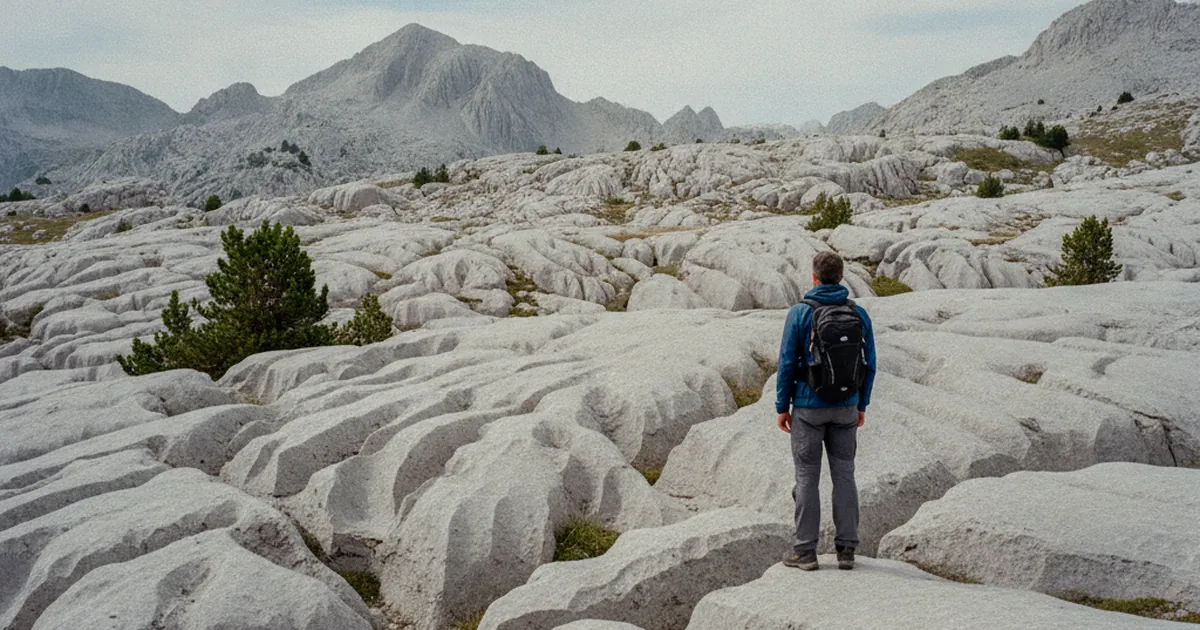
You never forget the first time you set foot on the Désert de Platé. The ground splits into a maze of rills, grooves, and rock blades stretching as far as the eye can see. This limestone plateau, perched above 2,000 metres in Haute-Savoie, is home to one of the largest lapiaz fields in France. Far more than a lunar landscape, it is a geology textbook lying open beneath your feet, reachable from the massifs of the Mont-Blanc area and the slopes above the Arve valley.
What is lapiaz?
Lapiaz (karren in German, lapies in older French spelling) is a type of erosion characteristic of limestone. Rainwater absorbs carbon dioxide from the atmosphere and becomes a weak carbonic acid. Over millennia, this mild but persistent acid slowly dissolves the rock, carving rills, grooves, and hollows into it. The result looks like a tortured surface, sharp-edged in places, sculpted as if by an invisible hand.
The most common forms on Platé are rill karren, parallel furrows ranging from a few centimetres to several decimetres deep, and clint-and-grike formations: raised blades separated by deep fissures. Between these ridges, circular depressions called dolines channel water directly down into underground networks, sometimes to great depths.
Urgonian limestone: the raw material of the plateau
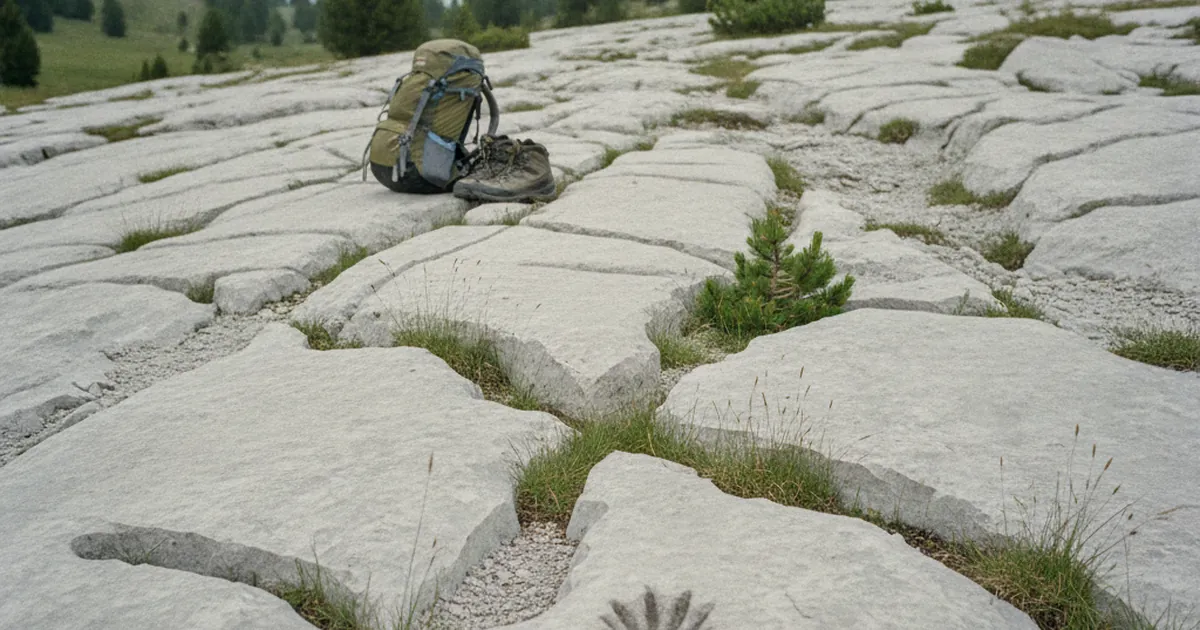
The Désert de Platé rests on a slab of Urgonian limestone, a rock formed in the Lower Cretaceous period roughly 125 million years ago, in a warm, shallow sea that covered this part of Europe at the time. This limestone, rich in corals and fossilised marine organisms, is unusually pure and compact: ideal conditions for karst to develop.
Alpine tectonic forces later lifted, tilted, and exposed this slab to the weather over millions of years, producing the geological spectacle you walk through today. The whiteness of the rock, dazzling in sunlight, is another hallmark of this Urgonian limestone. In certain lights, the plateau takes on cream or pinkish hues, and late-afternoon sun picks out every carved detail in sharp relief.
Moving safely across the lapiaz
Walking on lapiaz demands attention and stiff-soled boots. The fissures can be treacherous, especially when wet. A few practical tips for moving safely:
- Stick to flat sections or grassy strips between the rock blades whenever possible.
- Avoid jumping between blades unless you are confident of your footing.
- Wet lapiaz is slippery even with proper hiking boots.
- Do not stray from waymarked paths without a map: the plateau is large and the terrain repeats itself endlessly.
- In fog, progress becomes genuinely tricky as reduced visibility and similar-looking terrain make it easy to lose your bearings.
The plateau is also a sensitive environment. Plants tucked into the rock crevices are rare and fragile. Walk on marked trails and avoid stepping on vegetation unnecessarily.
Getting to the Désert de Platé
Several routes reach the plateau. From Flaine, accessible by road from Cluses in the Arve valley, ski-resort lifts operate in summer and give quick access to altitude. But the massif is equally rewarding on foot.
From Morillon, the climb through Les Esserts winds through pastures and forest before reaching the first limestone slabs. The Les Esserts from Morillon route is a good way to familiarise yourself with this corner of the massif without pushing all the way to the heart of the plateau.
From Sixt-Fer-à-Cheval, several paths climb towards the Sales massif and the edges of the plateau. Pointe de Sales remains a quieter summit than most of the massif, offering a striking view down over the whole lapiaz field and, on clear days, across to the Mont-Blanc range.
What to look for on the plateau
Take time to stop and look closely at the ground. In the rock crevices, specialist plants adapted to drought and cold have made their home: saxifrages, houseleeks, mountain avens. Marmots colonise the grassy areas around the plateau's edges. And if you peer into some of the deeper dolines, you may find snow still lingering well into July.
Photographers find compelling material here: the constantly shifting light and the textured limestone blades make for a dramatic foreground whatever the conditions. Clouds move fast at this altitude, and the quality of light changes in minutes. On clear days, the view extends all the way to Mont-Blanc, an added reward after the climb.
The Désert de Platé is an invitation to see the mountains differently. Not simply to admire a summit from below, but to walk through time, across rocks laid down long before our species existed. That is part of what makes hiking in Haute-Savoie so much more than physical exercise. This landscape speaks of geology, of deep time, and of the patient work of water on stone.