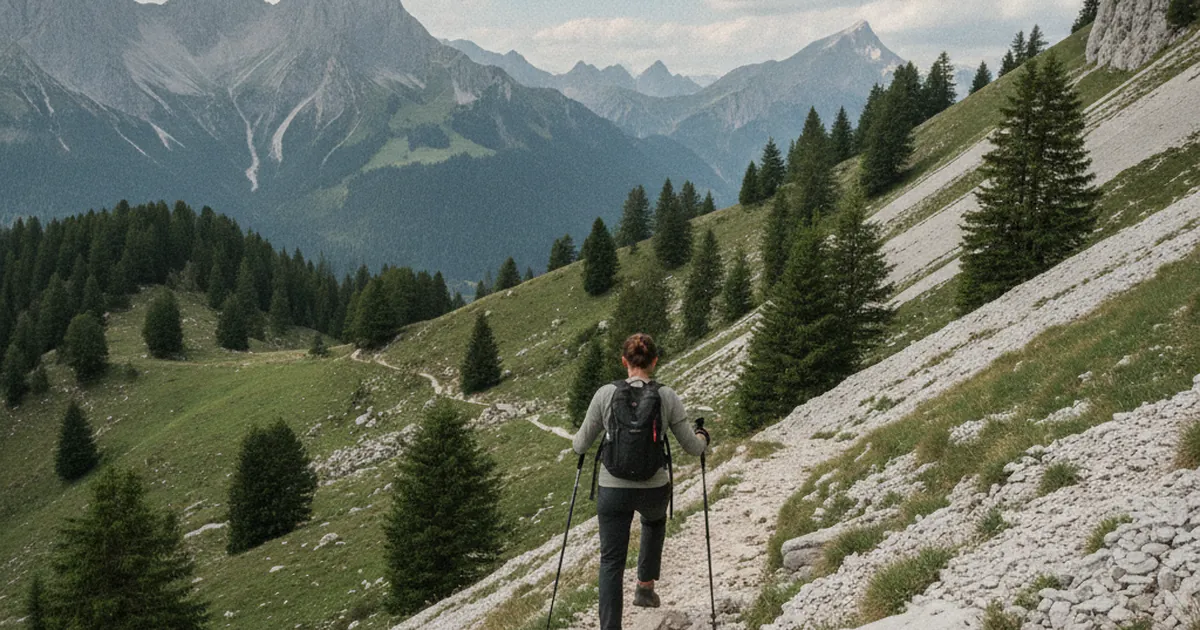
Everyone knows the climb burns the legs. What fewer people talk about is the descent wrecking the knees. After a long drop on steep terrain, the quads shake, the ankles wobble and the joints ache, even on short outings. Yet most hikers never actually work on their downhill technique. In Haute-Savoie, trails can plunge sharply over scree, wet rock or slippery grass. Knowing exactly what to do with your feet and poles makes the difference between hiking in Haute-Savoie safely and limping back to the car.
Posture: lean forward, not back
The most common mistake on steep descents is leaning backward. It feels safer, but it does the opposite: you shift all your weight onto the heels, lose grip and increase the risk of slipping.
The correct posture is a slight forward lean, knees bent, back straight. Arms open slightly away from the body to help with balance. Think of it as a moving half-squat: this position spreads the load across the whole sole and gives you the ability to adjust each footstep as the terrain changes.
It takes a few outings to make this automatic, especially on steep slopes. But once it clicks, it changes everything.
Foot placement: flat foot and constant adaptation
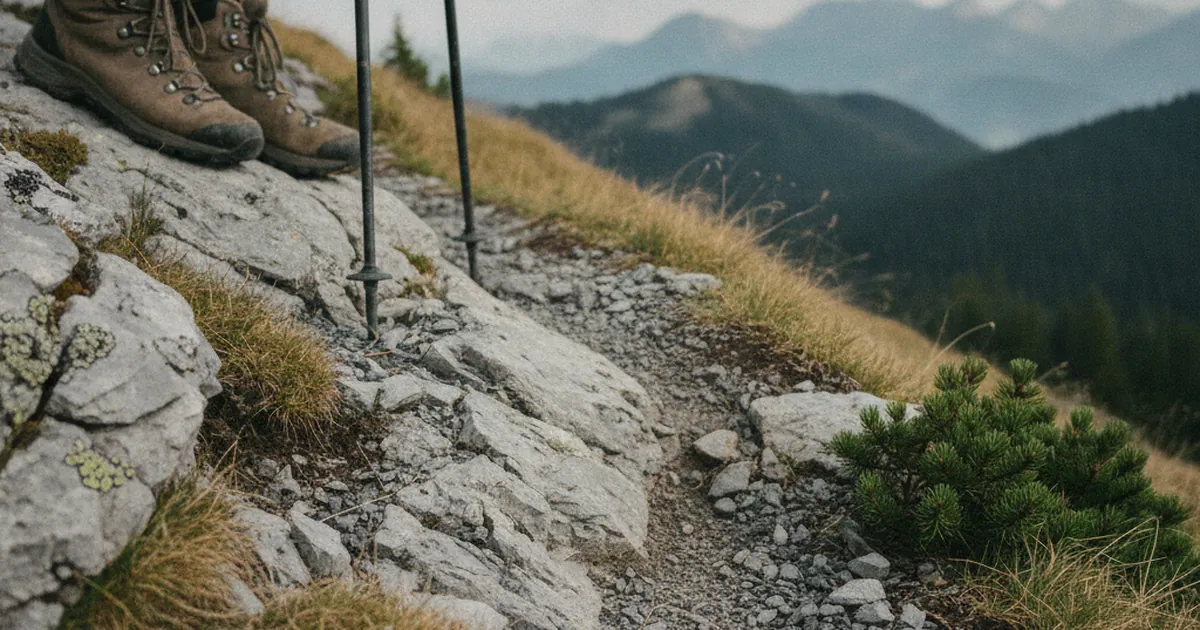
On dry, stable ground, place the foot flat: full sole contact, not toes, not heel alone. Maximum contact with the ground optimises grip and distributes the impact across the entire joint.
On slippery ground (wet grass, loose soil, damp limestone), two adaptations help:
- Descend diagonally or in a zigzag rather than straight down the slope, to reduce the sliding force along the fall line.
- Look for friction zones: rock edges, short dry grass, compacted earth rather than the worn and hollow centre of the trail.
Avoid locking your ankle. A flexible foot that adapts to the micro-texture of the ground is far more reliable than a rigid one.
Using poles on the descent
Many hikers stow their poles on the climb and pull them out on the way down, almost on instinct. That instinct is right: well-used poles absorb a significant share of the impact on your knees.
Basic technique: shorten the poles by 5 to 10 cm compared to the climb. Plant them forward at roughly 45 degrees, slightly to the side. Push through them at the moment of weight transfer, not after.
On very steep sections, feel free to plant both poles before each step. On technical ground (scree, rock slabs), keep the poles active for balance, but do not lean on them entirely: your primary stability must come from your foot contact with the ground.
Adapting to different terrain
Across the Aravis and Bornes massif and the wider Haute-Savoie mountains, you will encounter very different surfaces on any given descent. Here are the key adaptations:
- Scree: test each rock before committing your weight. Avoid isolated boulders. Slow right down, one step at a time, knees soft.
- Wet grass: grip can be near zero. Descend diagonally, knees bent, poles in contact with the ground at all times. Microspikes can be useful early or late in the season.
- Dry rock slabs: boot rubber grips well on dry limestone. Descend directly and with confidence. When wet, treat them like icy grass.
- Worn trail gullies: the centre of the path is often loose and hollow. Hug the edges where the soil is more compacted.
A route like Dent de Verreu par Vallon gives you a mix of these surfaces on a single outing, which makes it a good place to practise and compare.
Protecting your knees over time
Downhill can load each knee at up to three times your body weight per step. A few habits make a real difference:
- Shorten your stride: frequent short steps absorb impact far better than long bounding ones.
- Land on the forefoot first, never with a rigid heel strike: that sends the full shock directly into the knee joint.
- Vary your line: avoid descending in a straight line the whole way. Variation reduces repetitive loading on the same muscle groups.
- Take micro-breaks: one to two minutes every 20 to 30 minutes of sustained descent, to release tension in the quads and check your fatigue level before it becomes a hazard.
Off-trail conditioning matters too: eccentric exercises (slow squats, step-down lunges) replicate exactly the load your quads take on the descent and significantly reduce knee pain over time.
Downhill technique is not instinctive, it is learned. A forward-engaged posture, deliberate foot placement, well-adjusted poles and a short stride turn a gruelling descent into a controlled one. On the trails of Haute-Savoie, the vertical drops can be substantial: worth having the right habits before you head down. If you want a concrete place to put all this into practice, the col de Coux via the Mines d'Or offers a long and varied descent with plenty of different terrain types to work with.